Why Is Visual Content So Important on Instagram? Complete Guide to Visual Strategy
Discover why visual content dominates Instagram and how to create engaging visuals that drive engagement. Learn technical specifications, design principles, and best practices for Instagram success.
Why is visual content so important on Instagram?
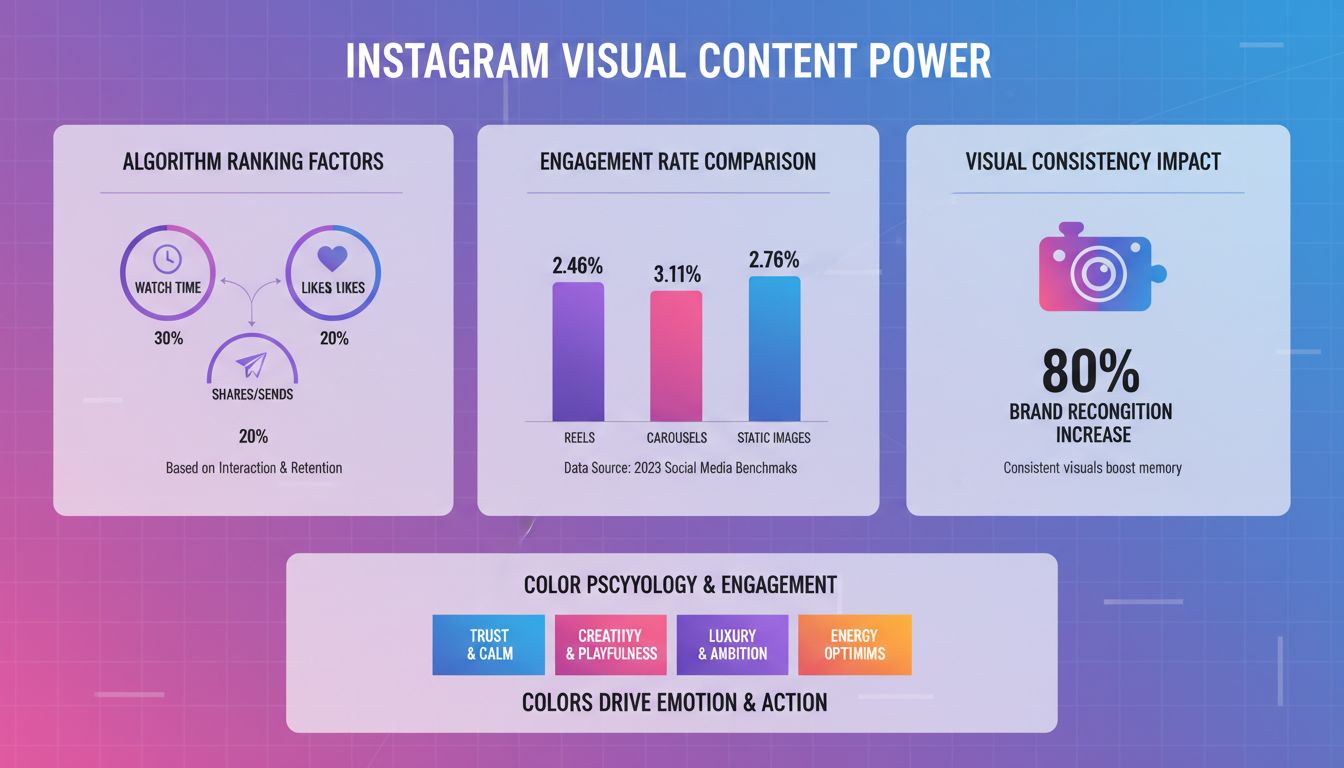
Visual content is crucial on Instagram because it's a visual-first platform where high-quality images and engaging visuals capture attention and drive engagement. Instagram's algorithm prioritizes visual content with strong watch time, likes, and shares, making compelling visuals essential for brand recognition, trust-building, and audience interaction.
Instagram was fundamentally designed as a visual-first platform, and this core principle shapes every aspect of how content performs on the network. Unlike text-based social media platforms, Instagram’s algorithm and user experience are optimized specifically for visual content consumption. The platform prioritizes images and videos because they communicate information faster and more effectively than text alone, allowing users to process brand messages, product information, and storytelling in seconds rather than minutes. This visual-centric design means that high-quality images and engaging visuals are not optional enhancements—they are the foundation of success on the platform.
The importance of visual content on Instagram extends beyond mere aesthetics. Research demonstrates that users get a clearer idea of brands, their values, and their products through visual content compared to text descriptions. When potential customers see graphics, infographics, or professionally edited photos, they can immediately understand what a brand offers and whether it aligns with their needs. This clarity inspires users to engage further with the brand, leading to higher click-through rates, more meaningful interactions, and ultimately better conversion outcomes. The visual nature of Instagram creates a unique opportunity for brands to tell their story in a way that resonates emotionally with their audience.
How Instagram’s Algorithm Prioritizes Visual Content
Instagram’s algorithm operates on a sophisticated ranking system that determines which content appears in users’ feeds, explore pages, and stories. The three most critical ranking signals for visual content are watch time, likes, and shares. Watch time measures how long users spend viewing your content—videos that keep viewers engaged for longer periods receive significant algorithmic boosts. Likes serve as a direct engagement signal indicating that users found your visual content valuable or entertaining enough to interact with it. Shares represent the highest form of engagement, as they indicate users found your content so compelling they wanted to distribute it to their own networks.
Different visual content formats receive different algorithmic treatment based on current platform priorities and user behavior patterns. Reels, Instagram’s short-form video feature, currently receive preferential treatment in the algorithm and generate an average engagement rate of 2.46%. Carousel posts, which allow users to swipe through multiple images, achieve a higher engagement rate of 3.11% due to their interactive nature and ability to tell more complex stories. Static images, while foundational to Instagram, generate an average engagement rate of 2.76%. This data reveals that while all visual formats perform well, the platform actively encourages more interactive and dynamic visual content. Understanding these algorithmic preferences allows content creators and marketers to optimize their visual strategy for maximum reach and engagement.
Technical Specifications for Optimal Visual Performance
Creating visually appealing content requires understanding Instagram’s technical requirements and specifications. Feed posts should be created at 1080 x 1350 pixels with a 4:5 aspect ratio, which ensures your images display perfectly without cropping or distortion. Stories require 1080 x 1920 pixels in a 9:16 aspect ratio to fill the entire screen and provide an immersive viewing experience. Reels also use the 1080 x 1920 pixel dimension but require specific video codec specifications—H.264 video codec with AAC audio at 128 kbps ensures optimal playback quality across all devices. Profile pictures should be square at 1080 x 1080 pixels, while carousel posts maintain the 1080 x 1350 pixel standard for each individual image.
File size and compression significantly impact how quickly your visual content loads and displays to users. Instagram recommends keeping file sizes under 8MB for optimal performance, though smaller files (2-4MB) load faster and provide better user experience on mobile devices. Using appropriate image compression without sacrificing quality is essential—tools like Photoshop, GIMP, Bannersnack, and Canva offer built-in compression features that maintain visual quality while reducing file size. Video files should be compressed to 4-6MB for Reels to ensure smooth playback without buffering. These technical specifications might seem detailed, but they directly impact how your visual content performs in the algorithm and how users perceive your brand’s professionalism.
Color Psychology and Visual Design Principles
Color selection plays a surprisingly powerful role in Instagram engagement and brand recognition. Research shows that 60% of purchase decisions are influenced by color alone, making color psychology a critical component of visual strategy. Different colors trigger different psychological responses: blue conveys trust and professionalism, red creates urgency and excitement, green represents growth and sustainability, yellow evokes happiness and optimism, and purple suggests creativity and luxury. When selecting colors for your Instagram visual content, consider what emotions and associations you want your brand to evoke in your audience.
Visual consistency in color usage dramatically impacts brand recognition and audience trust. Brands that maintain a consistent color palette across all posts experience an 80% increase in brand recognition compared to those that vary colors randomly. This consistency should extend beyond individual posts to your entire profile aesthetic—when users visit your Instagram profile, they should immediately recognize your brand through consistent color choices, filters, and editing styles. The timeline for achieving strong visual brand recognition through color consistency is approximately six months of consistent posting, after which 85% of your regular followers can identify your content without seeing your username. Implementing a cohesive color strategy using tools like Canva, which offers pre-built color palettes and brand kit features, ensures consistency across all your visual content.
Engagement Metrics and Performance Data
Understanding how different types of visual content perform helps inform strategic decisions about what to create and share. The engagement rate comparison reveals important insights: carousel posts achieve 3.11% engagement, static images achieve 2.76% engagement, and Reels achieve 2.46% engagement. While these percentages might seem similar, the volume of reach differs significantly—Reels typically reach 40% more users than static images due to algorithmic prioritization, meaning the absolute number of engagements is often higher despite a slightly lower percentage rate. Video content receives 40% more shares than static images, indicating that users find video content more shareable and worthy of distribution to their networks.
Content Format
Engagement Rate
Reach Multiplier
Share Rate
Best For
Carousel Posts
3.11%
1.2x
25% higher
Product showcases, tutorials
Static Images
2.76%
1.0x
Baseline
Brand aesthetics, quotes
Reels
2.46%
1.4x
40% higher
Entertainment, trends, education
Stories
2.89%
1.1x
15% higher
Time-sensitive content
IGTV/Long Videos
2.34%
1.3x
35% higher
In-depth content, behind-scenes
Video completion rates vary significantly based on video length, with videos under 15 seconds achieving 85% completion rates, videos between 15-30 seconds achieving 65% completion rates, and videos over 60 seconds dropping to 35% completion rates. This data suggests that shorter, more focused visual content performs better than lengthy productions. The optimal content mix for sustained growth appears to be 50% video content, 30% carousel posts, and 20% static images, though this should be adjusted based on your specific audience preferences and industry benchmarks.
Building Visual Consistency for Brand Recognition
Visual consistency extends far beyond color selection—it encompasses editing style, filter application, composition techniques, and overall aesthetic coherence. Brands that maintain consistent editing styles, such as using the same brightness, contrast, and saturation levels across all posts, experience 25-35% faster growth compared to brands that vary their editing approach. This consistency creates a recognizable visual signature that helps your content stand out in crowded feeds and makes your brand instantly identifiable to followers. When users scroll through Instagram and see your distinctive visual style, they immediately recognize it as your content without needing to read the caption or username.
Implementing visual consistency requires establishing clear guidelines for your content creation process. Define your brand’s preferred filter or editing preset, select a consistent color palette of three to five colors, establish composition rules (such as always including your product in the left third of the frame), and determine how you’ll incorporate your logo or branding elements. Tools like Canva’s brand kit feature allow you to save your color palette, fonts, and logos, ensuring every piece of visual content maintains consistency. This systematic approach to visual content creation not only improves brand recognition but also streamlines your content production process, allowing you to create more content in less time while maintaining quality standards.
Practical Tools for Creating High-Quality Visual Content
Creating professional-quality visual content doesn’t require expensive equipment or advanced design skills when you leverage the right tools. Photoshop remains the industry standard for advanced image editing, offering comprehensive tools for color correction, composition adjustment, and creative effects. GIMP provides a free, open-source alternative to Photoshop with most essential editing features for those on a budget. Bannersnack specializes in creating social media graphics and offers templates specifically designed for Instagram dimensions, making it easy to create on-brand visual content quickly. Canva democratizes design by providing drag-and-drop functionality, thousands of templates, and built-in brand kit features that ensure consistency across all your visual content.
Each tool serves different needs within your visual content strategy. Photoshop excels at detailed photo editing and complex compositions, making it ideal for product photography and lifestyle content. GIMP offers similar capabilities at no cost, making it perfect for creators just starting their visual content journey. Bannersnack specializes in quick graphic creation for promotional content, quotes, and announcement graphics. Canva combines ease of use with professional results, making it ideal for creating consistent, on-brand content across multiple formats and dimensions. Most successful Instagram marketers use a combination of these tools—perhaps using Photoshop for initial photo editing, then Canva for adding text overlays and maintaining brand consistency. The key is selecting tools that fit your skill level, budget, and content creation workflow.
Maximizing Visual Content Strategy for Affiliate Marketing
For affiliate marketers and those promoting products through Instagram, visual content strategy becomes even more critical. High-quality product photography, lifestyle images showing products in use, and comparison graphics significantly impact click-through rates and conversion rates. Affiliate marketers should focus on creating visual content that demonstrates product value, solves customer problems, and builds trust through authentic imagery. User-generated content—photos from actual customers using your affiliate products—performs exceptionally well because it provides social proof and authenticity that branded content alone cannot achieve.
Tracking the performance of your visual content across different formats and styles is essential for optimizing your affiliate marketing strategy. PostAffiliatePro provides comprehensive analytics that help you understand which types of visual content drive the most clicks, conversions, and revenue. By analyzing engagement metrics, click-through rates, and conversion data for different visual content formats, you can identify which visual strategies work best for your specific audience and products. This data-driven approach to visual content creation ensures you’re investing time and resources in creating the types of visual content that actually drive results for your affiliate marketing business.
Maximize Your Instagram Marketing with PostAffiliatePro
PostAffiliatePro helps you track and optimize your Instagram affiliate marketing campaigns with advanced analytics and performance metrics. Manage your visual content strategy and measure ROI across all your Instagram promotional efforts.
How Can I Find the Best Hashtags for My Instagram Posts? Complete 2025 Guide
Master Instagram hashtag research like SEO keywords. Learn to use TagBlender, HashTagsforLikes, Seekmetrics, and All Hashtag tools. Analyze competitor hashtags ...
Should I Change My Instagram Strategy If It's Already Working? 2025 Guide
Learn whether to change your working Instagram strategy. Discover when to optimize, adapt to new features, and maintain consistency for long-term success in 202...
Why Is Visual Content Important in Affiliate Campaigns?
Discover why visual content is crucial for affiliate marketing success. Learn how images, videos, and infographics boost engagement, conversions, and ROI in 202...
9 min read
You will be in Good Hands!
Join our community of happy clients and provide excellent customer support with Post Affiliate Pro.