Voice Broadcasting Benefits for Affiliate Marketing
Discover the key benefits of voice broadcasting in affiliate marketing: low startup costs, increased efficiency, and scalability. Learn how autodialers can boos...
11 min read

Learn what voice broadcasting is, how it works, and its applications in 2025. Discover the benefits of automated voice messaging for businesses and organizations.
Voice broadcasting is an automated mass communication technology that transmits pre-recorded audio messages to thousands of phone numbers simultaneously, enabling organizations to reach large audiences instantly for marketing, notifications, emergency alerts, and customer engagement.
Voice broadcasting, also known as voice message broadcasting or automated voice messaging, is a cloud-based mass communication technology that enables organizations to deliver pre-recorded audio messages to thousands of recipients simultaneously. This sophisticated system automates the process of contacting large audiences, making it an essential tool for modern businesses seeking efficient and scalable communication solutions. Unlike traditional manual calling methods where agents individually contact customers, voice broadcasting leverages automated dialing systems to reach multiple recipients in minutes, dramatically reducing the time and resources required for large-scale outreach campaigns. The technology has evolved significantly since its inception, incorporating advanced features like personalization, interactive voice response (IVR), and real-time analytics to provide comprehensive communication solutions.
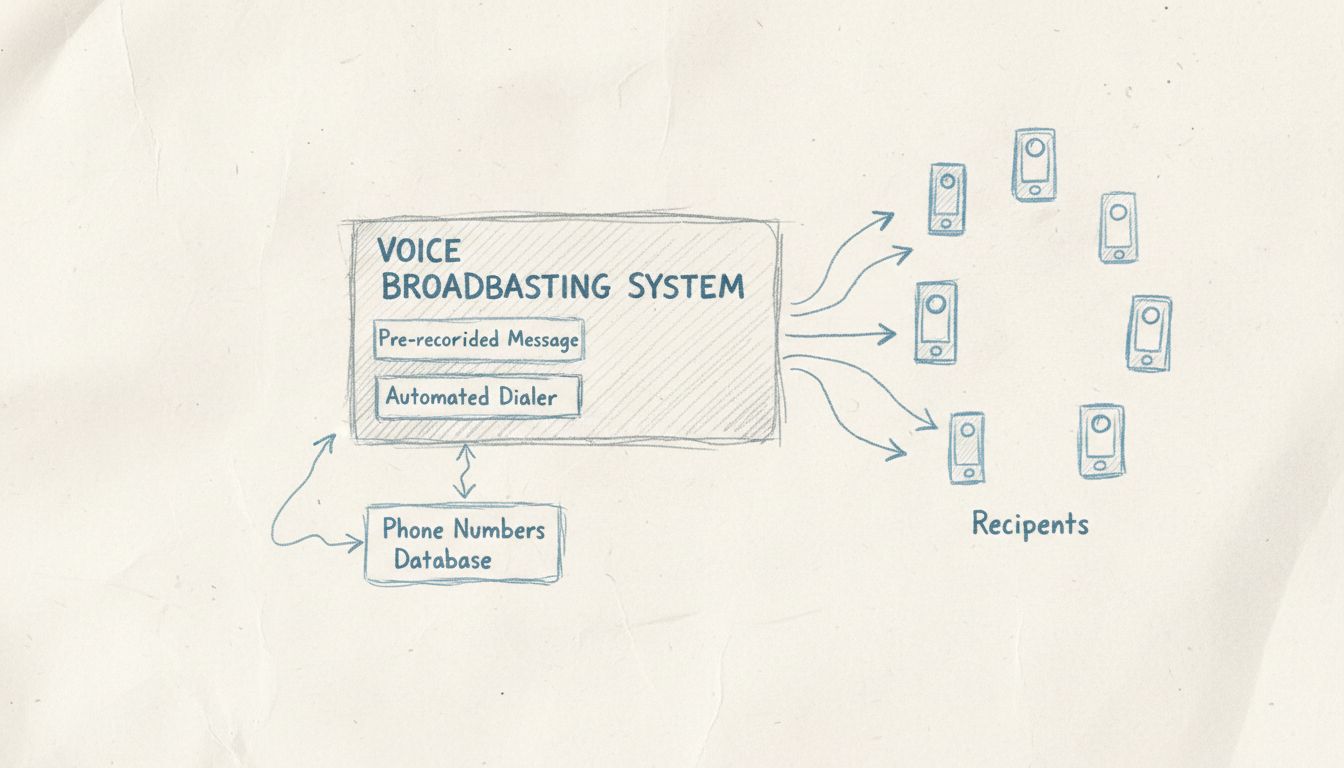
Voice broadcasting operates through a systematic process that combines several technological components working in harmony. The system begins with message creation, where organizations record or generate audio content using either human voice recordings or advanced text-to-speech technology. Once the message is prepared, it’s stored in the broadcasting system’s database alongside a comprehensive list of phone numbers representing the target audience. The automated dialer then initiates simultaneous calls to multiple recipients based on predefined parameters such as time zones, geographic locations, and scheduling preferences. When a recipient answers the call, the pre-recorded message plays automatically, ensuring consistent delivery of information across all recipients. The system can also incorporate interactive elements through IVR technology, allowing recipients to respond by pressing numeric keys on their phones, which enables feedback collection and call routing to live agents when necessary.
The technical infrastructure supporting voice broadcasting relies on cloud-based platforms that provide scalability and reliability. These systems utilize sophisticated algorithms to manage call queues, optimize connection rates, and handle failed attempts through automatic retry mechanisms. The architecture includes multiple redundancy layers to ensure message delivery even during peak usage periods, with load balancing across distributed servers to maintain consistent performance. Modern voice broadcasting platforms integrate with customer relationship management (CRM) systems and contact databases, enabling seamless data synchronization and campaign management. The technology also incorporates advanced security protocols to protect sensitive customer information and ensure compliance with telecommunications regulations and data protection standards.
| Feature | Description | Business Benefit |
|---|---|---|
| Simultaneous Multi-Recipient Delivery | Send messages to thousands of phone numbers at once | Reach entire customer base in minutes instead of days |
| Message Personalization | Customize messages with recipient names and data fields | Increase engagement and response rates significantly |
| Scheduled Campaigns | Set specific dates, times, and time zones for delivery | Optimize message delivery for maximum impact and compliance |
| Interactive Voice Response (IVR) | Allow recipients to respond via keypad input | Collect feedback and route calls to appropriate departments |
| Do-Not-Call (DNC) Compliance | Automatic filtering of DNC registry numbers | Avoid regulatory fines and maintain legal compliance |
| Real-Time Analytics | Monitor campaign performance with live dashboards | Track delivery rates, answer rates, and engagement metrics |
| Retry Mechanisms | Automatically resend to unanswered calls | Maximize reach and improve overall delivery success rates |
| Text-to-Speech Technology | Generate natural-sounding voice messages dynamically | Reduce production costs and enable rapid message updates |
| Call Recording and Logging | Maintain detailed records of all communications | Ensure accountability and support quality assurance |
| Multi-Language Support | Deliver messages in multiple languages | Reach diverse customer populations effectively |
Voice broadcasting serves diverse purposes across commercial and public sectors, making it an invaluable tool for organizations of all sizes. In the marketing domain, businesses leverage voice broadcasting to promote products and services, announce special offers, and generate qualified leads through targeted campaigns. Financial institutions utilize the technology for appointment reminders, payment notifications, and fraud alerts, significantly reducing no-show rates and improving customer service efficiency. Healthcare providers employ voice broadcasting for appointment confirmations, prescription refill reminders, and patient education initiatives, enhancing patient engagement and reducing administrative burden. Educational institutions use the technology to communicate important announcements, emergency notifications, and event invitations to students, parents, and staff members. Government agencies and non-profit organizations deploy voice broadcasting for emergency alerts, public health notifications, and community engagement initiatives, ensuring rapid dissemination of critical information during emergencies or urgent situations.
The versatility of voice broadcasting extends to customer satisfaction surveys and market research initiatives, where organizations collect valuable feedback from large customer populations efficiently. Retail businesses utilize voice broadcasting for inventory notifications, store opening announcements, and seasonal promotions. Utility companies employ the technology for service outage notifications and billing reminders. Event organizers use voice broadcasting to send event reminders, last-minute updates, and post-event follow-ups. The technology has proven particularly valuable in election campaigns, where political organizations reach voters with campaign messages and voting information. Insurance companies leverage voice broadcasting for policy renewal reminders, claims updates, and customer service notifications, improving customer retention and satisfaction metrics.
Voice broadcasting offers substantial advantages compared to traditional communication approaches and alternative mass messaging technologies. Voice messages demonstrate significantly higher engagement rates than text-based communications, as research indicates that voice messaging represents the future of mobile communication, with increasing adoption among consumers who prefer audio content. The technology enables organizations to maintain absolute message consistency, eliminating the risk of information alteration that occurs when human agents manually communicate with customers. Voice broadcasting dramatically reduces operational costs by eliminating the need for large teams of call center agents, allowing organizations to reach thousands of customers with minimal resource investment. The scalability of voice broadcasting enables businesses to expand their outreach efforts without proportional increases in operational expenses, making it ideal for growing organizations with ambitious communication goals.
The speed of voice broadcasting provides competitive advantages in time-sensitive situations, enabling organizations to reach entire customer bases within minutes rather than hours or days. The technology’s integration with advanced analytics provides valuable insights into campaign performance, recipient engagement, and message effectiveness, enabling data-driven optimization of future campaigns. Voice broadcasting systems offer superior compliance capabilities, automatically filtering do-not-call registry numbers and maintaining detailed audit trails for regulatory compliance. The personalization capabilities of modern voice broadcasting platforms enable organizations to create more engaging and relevant messages, significantly improving response rates and customer satisfaction. The flexibility of voice broadcasting accommodates various communication scenarios, from emergency notifications requiring immediate delivery to scheduled campaigns optimized for specific time windows and geographic regions.
Organizations implementing voice broadcasting must navigate a complex regulatory landscape designed to protect consumer privacy and prevent abuse of telecommunications technology. The Telephone Consumer Protection Act (TCPA) in the United States establishes strict requirements for voice broadcasting campaigns, including mandatory do-not-call list compliance, prior express written consent requirements for certain message types, and restrictions on calling times. The General Data Protection Regulation (GDPR) in Europe imposes stringent requirements on organizations processing personal data for voice broadcasting campaigns, requiring explicit consent and providing individuals with comprehensive data protection rights. Similar regulations exist in other jurisdictions, including Canada’s Personal Information Protection and Electronic Documents Act (PIPEDA) and Australia’s Privacy Act, each establishing specific requirements for voice broadcasting implementation.
Compliance with these regulations requires organizations to maintain accurate do-not-call registries, implement robust consent management systems, and maintain detailed records of all communications. Voice broadcasting platforms must incorporate automatic DNC filtering to prevent calls to protected numbers, with regular updates to ensure compliance with current registry data. Organizations must also establish clear opt-out mechanisms, allowing recipients to request removal from future campaigns. The regulatory environment continues to evolve, with increasing emphasis on consumer protection driving innovation in compliance technologies and consent management systems. Organizations staying current with these trends and adopting compliant voice broadcasting solutions will maintain competitive advantages while avoiding potential legal and financial consequences.
Voice broadcasting stands out among mass communication technologies when compared to SMS messaging, email campaigns, and social media outreach. While SMS messaging offers high open rates, voice messages provide superior engagement through the personal nature of audio communication, with recipients more likely to listen to complete messages compared to reading text. Email campaigns enable detailed content delivery but suffer from lower open rates and higher spam filtering challenges. Voice broadcasting combines the immediacy of phone communication with the scalability of automated systems, creating a unique value proposition unavailable through alternative channels. PostAffiliatePro integrates voice broadcasting capabilities with its comprehensive affiliate marketing platform, enabling businesses to combine voice outreach with performance-based marketing strategies for maximum impact and measurable results.
The effectiveness of voice broadcasting in driving customer engagement and response rates significantly exceeds traditional outbound calling methods, which require substantial human resources and suffer from consistency challenges. Interactive voice broadcasting adds another dimension by enabling two-way communication, allowing recipients to provide feedback, request information, or connect with live agents without requiring manual intervention. The combination of voice broadcasting with other communication channels creates an omnichannel strategy that maximizes reach and engagement across diverse customer preferences and communication habits. Organizations leveraging multiple communication technologies, including voice broadcasting, achieve superior results compared to single-channel approaches, with voice broadcasting serving as a critical component of comprehensive customer communication strategies.
Successful voice broadcasting implementation requires careful planning, strategic message design, and continuous optimization based on performance metrics. Organizations should begin by clearly defining campaign objectives, identifying target audiences, and establishing key performance indicators (KPIs) to measure success. Message content should be concise, compelling, and action-oriented, with clear calls-to-action that guide recipients toward desired outcomes. Timing optimization ensures messages reach recipients during appropriate hours, considering time zones and recipient preferences to maximize engagement and minimize complaints. Segmentation strategies enable organizations to tailor messages to specific audience groups, improving relevance and response rates compared to generic broadcasts.
Testing and refinement processes should precede full-scale campaign launches, with pilot programs validating message effectiveness and system performance before reaching entire customer bases. Organizations should monitor key metrics including delivery rates, answer rates, engagement rates, and conversion rates, using these insights to continuously improve campaign performance. Integration with CRM systems enables sophisticated tracking of customer interactions and campaign outcomes, providing valuable data for future optimization. Regular compliance audits ensure ongoing adherence to regulatory requirements, protecting organizations from potential legal and financial consequences. Training programs for staff members responsible for campaign management ensure proper system utilization and compliance with organizational policies and regulatory requirements.
The voice broadcasting landscape continues to evolve with emerging technologies and changing consumer preferences shaping the future of mass communication. Artificial intelligence and machine learning are increasingly integrated into voice broadcasting platforms, enabling predictive analytics, automated optimization, and enhanced personalization capabilities. Natural language processing improvements are making text-to-speech technology more sophisticated, producing increasingly natural-sounding voice messages that enhance recipient engagement. Integration with voice assistants and smart home devices is expanding the reach of voice broadcasting beyond traditional phone channels, enabling organizations to connect with customers through emerging communication platforms. Blockchain technology is being explored for enhanced security and transparency in voice broadcasting systems, particularly for sensitive applications requiring immutable audit trails.
The convergence of voice broadcasting with other communication technologies is creating integrated platforms that enable seamless omnichannel communication strategies. Advanced analytics and artificial intelligence are enabling predictive modeling of campaign outcomes, allowing organizations to optimize campaigns before launch. Personalization capabilities are becoming increasingly sophisticated, with dynamic message generation based on real-time customer data and behavioral patterns. The regulatory environment continues to evolve, with increasing emphasis on consumer protection driving innovation in compliance technologies and consent management systems. Organizations staying current with these trends and adopting advanced voice broadcasting platforms will maintain competitive advantages in customer communication and engagement throughout 2025 and beyond.
PostAffiliatePro's advanced voice broadcasting integration enables you to reach your entire customer base with personalized, automated messages. Scale your outreach campaigns while maintaining message consistency and compliance.
Discover the key benefits of voice broadcasting in affiliate marketing: low startup costs, increased efficiency, and scalability. Learn how autodialers can boos...
Discover how voice broadcasting transforms affiliate marketing with mass reach, real-time engagement, and higher conversion rates. Learn key benefits and implem...
Learn how podcasting works in 2025. Discover RSS feeds, hosting platforms, distribution methods, and the complete technical process behind podcast creation and ...
Join our community of happy clients and provide excellent customer support with Post Affiliate Pro.



Cookie Consent
We use cookies to enhance your browsing experience and analyze our traffic. See our privacy policy.