Keyword Match Types Explained: Broad vs Phrase vs Exact Match
Understand the differences between broad, phrase, and exact match types for PPC advertising. Learn how each match type works, their pros and cons, and best practices for affiliate marketing campaigns.
What's the difference between broad, phrase, and exact match types?
Broad match shows ads for related searches including synonyms and variations, phrase match requires the exact phrase in the correct order, and exact match only triggers for searches that precisely match your keyword or close variations.
Understanding Keyword Match Types in PPC Advertising
Keyword match types are fundamental settings in pay-per-click advertising that determine how closely a user’s search query must align with your chosen keywords for your ads to be displayed. These match types serve as the bridge between what customers are searching for and the ads you want to show them, making them critical for campaign success. In 2025, understanding and properly implementing match types remains essential for affiliate marketers, e-commerce sellers, and digital advertisers looking to maximize their return on ad spend. The choice between broad, phrase, and exact match types directly impacts your campaign’s reach, relevance, and profitability.
Broad Match: Maximum Reach and Discovery
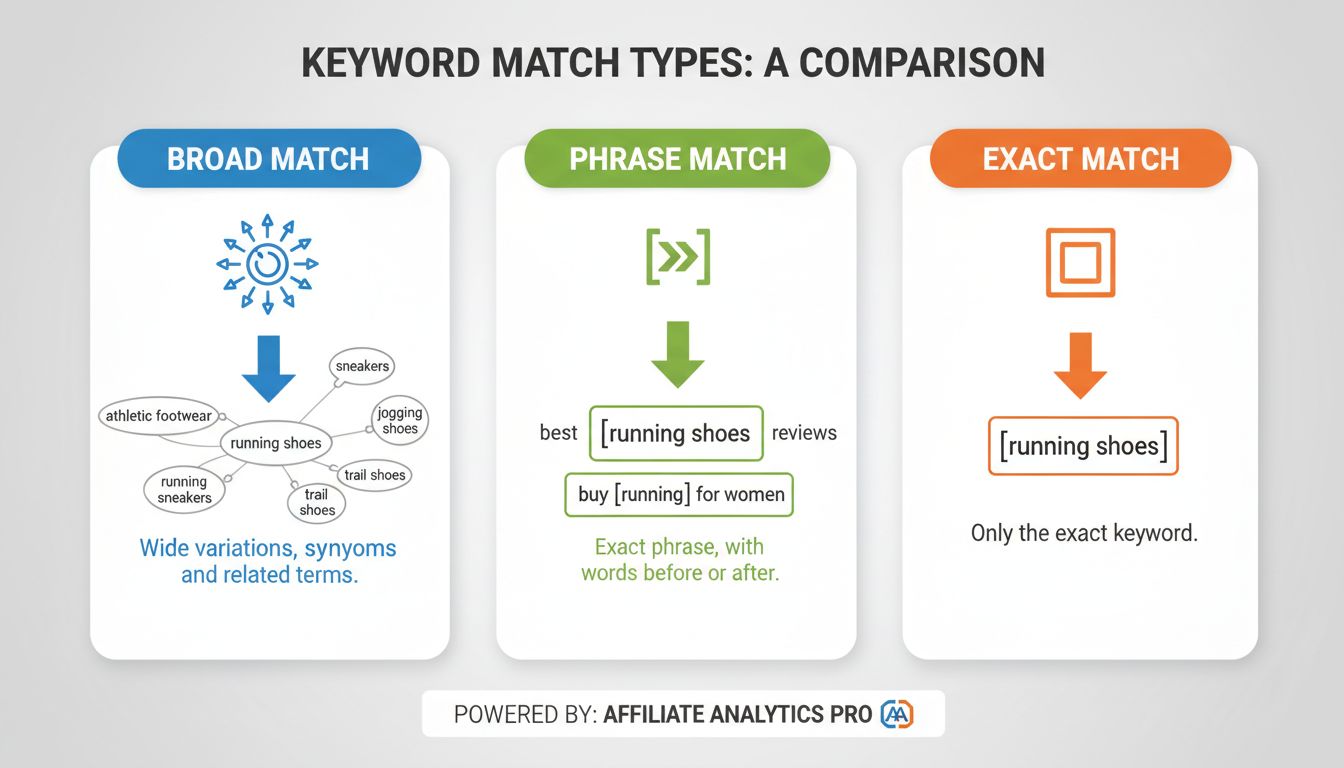
Broad match is the most expansive match type available, designed to cast the widest net possible across customer search queries. When you use broad match keywords, your ads can appear for searches that include synonyms, plurals, variations, misspellings, and related terms based on the keyword’s meaning and the context of your advertised products. The keyword itself doesn’t even need to be present in the customer’s search query for a match to occur. For example, if you bid on the broad match keyword “running shoes,” your ads could appear for searches like “athletic footwear,” “sneakers,” “canvas shoes,” “jogging trainers,” or even “marathon footwear.”
The primary advantage of broad match is its ability to maximize impressions and reach new audiences you might not have considered. This match type excels at keyword discovery, helping you identify new search terms and customer intent patterns that could drive valuable traffic to your offers. Broad match often results in lower cost-per-click rates compared to more restrictive match types because you’re capturing a larger volume of searches. However, this comes with a significant trade-off: broad match frequently triggers ads for irrelevant searches, leading to wasted ad spend on clicks unlikely to convert. The lack of precision means you lose control over exactly which search terms trigger your ads, making it challenging to accurately attribute conversions and maintain acceptable cost-per-acquisition metrics.
Phrase Match: Balanced Targeting and Control
Phrase match occupies the middle ground between broad and exact match types, offering a more targeted approach while maintaining some flexibility. With phrase match keywords, your ads appear when a customer’s search query contains your exact keyword phrase in the correct word order, though additional words can appear before or after the phrase. If you bid on the phrase match keyword “running shoes,” your ads would display for searches like “best running shoes,” “running shoes for women,” “affordable running shoes,” or “latest running shoe releases,” but not for “shoes for running” where the word order is reversed.
Phrase match provides significantly tighter control over ad placement compared to broad match, allowing you to maintain better alignment between customer intent and your offers. This match type effectively prevents “leaky spending” by filtering out many irrelevant searches while still capturing variations that indicate genuine customer interest. Phrase match facilitates the discovery of high-relevance search terms that closely align with your targeted keywords, helping you identify and capitalize on customer queries with strong purchase intent. The trade-off is that phrase match typically generates fewer impressions than broad match because of its more restrictive matching requirements, and the cost-per-click tends to be higher due to the increased relevance and specificity of the targeting.
Exact Match: Precision and High Intent
Exact match is the most restrictive match type, designed for advertisers who prioritize precision and want to target only the most specific customer searches. With exact match keywords, your ads display only when a customer’s search query exactly matches your keyword or includes very close variations. If you bid on the exact match keyword “running shoes,” your ads would appear for searches like “running shoes” or “best running shoes,” but not for “shoes for running” or “running shoe store.” Exact match also includes plurals and close variations that Google or Amazon determines share the same meaning or intent.
The primary strength of exact match is the exceptional level of control it provides over ad placements and spending. There is a clear one-to-one attribution between your exact keywords and customer search terms, allowing for precise tracking of performance metrics and accurate insights into keyword effectiveness. When your keyword and product align perfectly with what customers are searching for, exact match delivers exceptional return on investment and attracts users with the highest purchase intent. However, exact match offers no opportunity to discover new search terms or variations, potentially causing you to miss relevant traffic that uses slightly different phrasing. The cost-per-click for exact match keywords is often the highest among all match types, and in competitive categories, exact match bidding can trigger bidding wars with competitors, driving up acquisition costs significantly.
Comparative Analysis: Match Types Side by Side
Aspect
Broad Match
Phrase Match
Exact Match
Reach
Widest reach, maximum impressions
Moderate reach and impressions
Limited reach, lowest impressions
Relevance
Lower relevance, many variations
Higher relevance, controlled variations
Highest relevance, precise matching
Cost Per Click
Typically lowest CPC
Medium CPC
Usually highest CPC
Control
Minimal control over matched queries
Good control with some flexibility
Maximum control over placements
Keyword Discovery
Excellent for finding new keywords
Good for discovering related terms
No discovery of new variations
Conversion Quality
Lower conversion rates on average
Higher conversion rates
Highest conversion rates
Best For
Brand awareness, reach, testing
Balanced campaigns, mid-funnel
High-intent, branded, competitive terms
Negative Keywords
Essential for cost management
Recommended for optimization
Optional but helpful
Advanced Match Type Strategies for 2025
Modern PPC platforms have introduced enhanced versions of traditional match types that provide additional control and flexibility. Broad match modifiers (available in Google Ads and Amazon Advertising) allow you to add a plus symbol (+) before specific words in a broad match keyword to require those terms in the search query. For example, “+running +shoes” ensures that both “running” and “shoes” must appear in the customer’s search, though not necessarily in that order or consecutively. This hybrid approach combines the discovery potential of broad match with the control of phrase match, making it an excellent option for many affiliate marketers.
PostAffiliatePro users benefit from advanced campaign management tools that help optimize keyword match type strategies across multiple advertising platforms. The platform’s comprehensive tracking and reporting capabilities allow you to monitor performance metrics for each match type separately, enabling data-driven decisions about which match types to prioritize for specific products or campaigns. By analyzing conversion data, cost-per-acquisition, and return on ad spend across match types, you can identify which approach delivers the best results for your specific affiliate offers and adjust your strategy accordingly.
Implementing Match Types Effectively
The most successful PPC campaigns typically use a combination of all three match types, each serving a specific purpose within your overall strategy. Start with broad match keywords in separate campaigns or ad groups to discover new search terms and identify emerging customer interests. Monitor the search term reports closely and add negative keywords to prevent irrelevant matches. Use phrase match keywords for your core offerings and primary keywords where you want to balance reach with relevance. Reserve exact match keywords for your highest-performing terms, branded keywords, and competitor keywords where you want maximum control and precision.
Testing is crucial when implementing match type strategies. Create controlled experiments by duplicating campaigns and changing only the match type while keeping other variables constant. This allows you to measure the true impact of match type selection on your campaign performance. Track metrics like click-through rate, conversion rate, cost-per-acquisition, and return on ad spend for each match type to understand which approach works best for your specific products and target audience. Remember that match type performance can vary significantly based on your industry, product type, and target market, so what works for one affiliate offer may not work for another.
Common Mistakes to Avoid
One of the most common mistakes affiliate marketers make is relying exclusively on exact match keywords, thinking this will eliminate wasted spend. While exact match does provide precision, it also severely limits your reach and prevents you from discovering new profitable keywords and customer segments. Conversely, using only broad match without proper negative keyword management can quickly drain your budget on irrelevant clicks. Another frequent error is failing to monitor search term reports regularly, which means you miss opportunities to add negative keywords and prevent wasteful spending on close variants that don’t convert.
Many advertisers also make the mistake of not adjusting their match type strategy based on campaign performance data. Your match type approach should evolve as you gather more information about which searches actually convert for your offers. Additionally, ignoring the differences between match type implementations across platforms can lead to suboptimal results. Google Ads, Amazon Advertising, and other platforms have slightly different matching algorithms and close variant rules, so strategies that work perfectly on one platform may need adjustment for another.
Future Trends in Keyword Matching
As artificial intelligence and machine learning continue to advance, keyword matching is becoming increasingly sophisticated. Search engines are moving toward more intelligent matching that better understands user intent rather than just matching keywords literally. This trend suggests that exact match will become even more precise, while broad match will become smarter at filtering out truly irrelevant searches. For affiliate marketers, this means the importance of understanding and properly implementing match types will only increase, as will the value of platforms like PostAffiliatePro that help you track and optimize performance across different match types and advertising channels.
Optimizing Your Affiliate Marketing with Match Type Mastery
Understanding the nuances of broad, phrase, and exact match types is essential for building profitable affiliate marketing campaigns in 2025. Each match type serves a specific purpose and offers distinct advantages and disadvantages that must be carefully weighed against your campaign objectives. Broad match excels at discovery and reach but requires vigilant negative keyword management. Phrase match provides the balanced approach many affiliate marketers prefer, offering good control while maintaining reasonable reach. Exact match delivers precision and high-intent targeting but limits your ability to discover new opportunities and can result in higher acquisition costs.
The key to success is implementing a strategic combination of all three match types, continuously monitoring performance data, and adjusting your approach based on what the data reveals about your specific audience and offers. PostAffiliatePro’s advanced tracking and reporting capabilities make it easier than ever to analyze match type performance across your entire affiliate portfolio, enabling you to make informed decisions that maximize your return on advertising spend. By mastering keyword match types and implementing them strategically, you position yourself to compete effectively in the increasingly sophisticated world of performance marketing.
Optimize Your Affiliate Campaigns with PostAffiliatePro
Master keyword matching strategies and maximize your affiliate marketing ROI with PostAffiliatePro's advanced campaign management tools. Track performance across all match types and optimize your keyword strategy in real-time.
Are Negative Keywords an Exact Match? Understanding Negative Keyword Match Types
Learn how negative keywords work with different match types (broad, phrase, exact) in Google Ads and affiliate marketing. Master negative keyword strategies to ...
Discover the four main types of paid search advertising: CPC, CPM, CPA, and CPL. Learn how each model works, when to use them, and how to optimize your affiliat...
Is PPC Advertising Suitable for All Affiliate Marketers?
Discover if PPC advertising is right for your affiliate marketing strategy. Learn about benefits, challenges, and best practices for all niches in 2025.
10 min read
You will be in Good Hands!
Join our community of happy clients and provide excellent customer support with Post Affiliate Pro.