
Spot vs Commercial: Understanding Key Advertising Terminology
Learn the essential difference between advertising spots and commercials. Understand how spots function as time slots for commercials and how this distinction i...
9 min read

Learn the fundamental difference between a commercial and a spot in advertising. Discover how commercials are content while spots are time slots, and how this impacts your advertising strategy in 2025.
No, a commercial is the content that is broadcast and a spot is the length of time it covers.
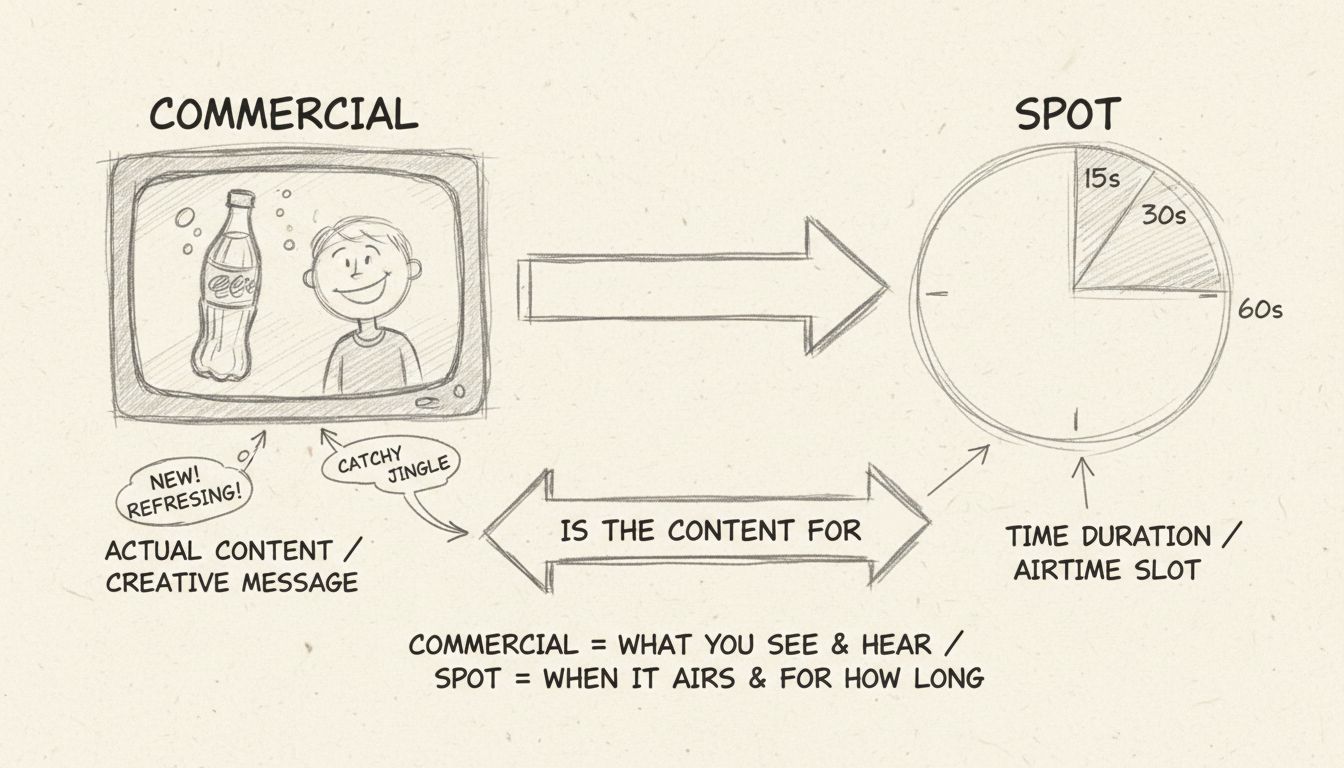
The terms “commercial” and “spot” are often used interchangeably in the advertising industry, but they represent two distinctly different concepts that are crucial to understand for effective media planning and campaign execution. A commercial refers to the actual advertisement content itself—the creative message, visuals, audio, and overall production that communicates a brand’s message to an audience. In contrast, a spot refers specifically to the predetermined time slot or duration during which that commercial is broadcast, typically measured in seconds. This distinction is fundamental to how advertising is bought, sold, and measured across all media channels including television, radio, and digital platforms.
Understanding this difference is essential for anyone involved in advertising, marketing, or affiliate marketing campaigns. When advertisers purchase advertising time, they are not simply buying a commercial; they are purchasing specific spots—time slots of defined lengths—during which their commercial content will be aired. The confusion between these two terms often leads to miscommunication between advertisers, media buyers, and broadcasters, potentially resulting in inefficient spending and suboptimal campaign performance. PostAffiliatePro recognizes this distinction and helps marketers optimize their spot purchasing and commercial placement strategies through advanced tracking and analytics.
A commercial is the complete advertisement package that includes all creative elements designed to promote a product, service, or brand. This encompasses the script, visual design, music, voice-over, special effects, and any other production elements that combine to create the final advertisement. Commercials are carefully crafted pieces of content that reflect a brand’s identity, messaging strategy, and marketing objectives. The production of a commercial involves multiple stages including concept development, scriptwriting, storyboarding, casting, filming, and post-production editing. Each element is meticulously planned to ensure the commercial effectively communicates the intended message and resonates with the target audience.
The quality and effectiveness of a commercial depend on numerous factors including creative concept, production value, talent selection, and how well the message aligns with audience preferences. A commercial can range from a simple product demonstration to an elaborate narrative that builds emotional connections with viewers. The content of a commercial is what actually captures audience attention and drives engagement, making it the most critical component of any advertising campaign. In the context of affiliate marketing, commercials serve as the promotional vehicles that drive traffic to affiliate links and encourage conversions. PostAffiliatePro’s campaign management tools help affiliates create and track the performance of their commercial content across multiple channels.
A spot represents the specific time allocation purchased for broadcasting a commercial. In traditional television and radio advertising, spots are standardized into specific durations that have become industry norms. The most common spot lengths are 15 seconds, 30 seconds, 45 seconds, and 60 seconds, though digital platforms have introduced additional variations including 6-second pre-roll ads and other custom durations. The 30-second spot has historically been the most prevalent format, accounting for approximately 49% of all television commercials according to recent industry data. However, the advertising landscape is evolving, with shorter 15-second and 6-second spots gaining market share, particularly in digital and streaming environments.
The selection of spot length is a strategic decision that impacts both the cost of advertising and the effectiveness of the message. Shorter spots are generally less expensive to produce and purchase, making them accessible to smaller advertisers and allowing for higher frequency of ad placements. Longer spots provide more time to develop a narrative, explain product features, or build emotional connections with the audience. The choice between spot lengths depends on multiple factors including the advertising objective, target audience, budget constraints, and the specific media channel being used. In 2025, the trend continues toward shorter spots in digital channels while traditional television maintains a mix of spot lengths. Understanding spot duration is critical for affiliate marketers who need to optimize their advertising spend and maximize return on investment.
The relationship between commercials and spots is symbiotic—a commercial cannot be broadcast without a spot, and a spot has no value without commercial content to fill it. When an advertiser decides to launch a campaign, they must first create or produce the commercial content, then purchase spots during which that commercial will be aired. A single commercial can be broadcast across multiple spots at different times, on different channels, or during different programs. This strategy allows advertisers to maximize reach and frequency while potentially using the same creative content across multiple placements. The cost structure of advertising reflects this relationship: advertisers pay for the spot (the time slot), while the production of the commercial is a separate investment.
Media buyers and advertising agencies specialize in identifying the most valuable spots for specific commercials based on audience demographics, viewing patterns, and campaign objectives. They analyze data about when and where target audiences are most likely to be watching or listening, then strategically place commercials in those spots to maximize impact. This process has become increasingly sophisticated with the advent of programmatic advertising and data analytics. In the digital age, the distinction between commercials and spots has become even more important as advertisers can now purchase highly targeted spots based on user behavior, location, and preferences. PostAffiliatePro’s advanced reporting and tracking capabilities enable affiliate marketers to understand which spots and placements generate the highest-quality traffic and conversions.
The concept of spots varies slightly across different media channels, though the fundamental principle remains consistent. In television advertising, spots are the standard unit of purchase, with networks and local stations offering inventory in 15, 30, 45, and 60-second increments. Television spots are typically sold based on daypart (time of day), program, and expected audience size. In radio advertising, spots follow a similar model with standardized durations, though radio spots are often more affordable than television equivalents due to lower production costs and smaller audience sizes. Radio spots are frequently purchased in packages or “flights” to achieve desired frequency and reach.
Digital advertising has introduced more flexibility in spot lengths and purchasing models. Online video platforms like YouTube offer pre-roll ads (shown before content), mid-roll ads (during content), and post-roll ads (after content), with durations ranging from 6 seconds to several minutes. Social media platforms have their own spot standards, with Facebook and Instagram offering various ad formats and durations. Streaming services have created new spot opportunities, with both ad-supported tiers of subscription services and connected TV (CTV) advertising providing premium placements. The rise of programmatic advertising has made spot purchasing more automated and data-driven, allowing advertisers to bid for specific spots in real-time based on audience targeting parameters. Understanding these channel-specific variations is essential for developing comprehensive advertising strategies that leverage the strengths of each medium.
The financial aspects of advertising are directly tied to the distinction between commercials and spots. Commercial production costs are separate from spot purchasing costs and can vary dramatically based on production quality, talent, location, and complexity. A simple commercial might cost a few thousand dollars to produce, while a high-production-value commercial featuring celebrity talent and elaborate special effects can cost hundreds of thousands or even millions of dollars. These production costs are typically one-time investments that can be amortized across multiple spot placements.
Spot purchasing costs depend on several factors including the media channel, time slot, audience size, and market. Prime-time television spots command premium prices due to larger audiences, while off-peak spots are significantly less expensive. The cost per thousand viewers (CPM) is a standard metric used to compare spot costs across different channels and time slots. In 2025, television spot costs continue to vary widely based on market size and program popularity, with national prime-time spots costing substantially more than local or cable spots. Digital spots often offer more flexible pricing models including cost-per-click (CPC), cost-per-view (CPV), and cost-per-action (CPA), allowing advertisers to pay only for desired outcomes. Understanding both production and spot costs is critical for developing efficient advertising budgets and maximizing return on investment.
The effectiveness of advertising campaigns depends on evaluating both the commercial content and the spot placement strategy. Commercial effectiveness is measured through metrics such as brand recall, message comprehension, emotional impact, and creative engagement. These metrics assess how well the commercial content communicates the intended message and resonates with viewers. Spot effectiveness is measured through reach, frequency, audience demographics, and conversion metrics. Reach refers to the total number of unique individuals exposed to the commercial, while frequency measures how many times each individual sees the commercial. Together, reach and frequency determine the overall impact and efficiency of the spot buying strategy.
| Metric | Commercial Focus | Spot Focus |
|---|---|---|
| Brand Recall | Measures how well viewers remember the brand after seeing the commercial | Influenced by frequency and placement of spots |
| Message Comprehension | Evaluates if viewers understand the key message in the commercial | Enhanced by strategic spot placement during relevant content |
| Reach | Not directly measured at commercial level | Total unique viewers across all spots |
| Frequency | Not directly measured at commercial level | Average number of times viewers see the commercial |
| Conversion Rate | Influenced by commercial creative quality | Influenced by spot placement and audience targeting |
| Cost Efficiency | Production cost per commercial | Cost per thousand viewers (CPM) or cost per conversion |
Advanced analytics platforms now allow advertisers to track the performance of specific commercials across different spots and channels, providing insights into which combinations generate the best results. This data-driven approach enables continuous optimization of both creative content and spot purchasing strategies. PostAffiliatePro’s comprehensive reporting tools help affiliate marketers track which traffic sources and placements deliver the highest-quality conversions, enabling them to optimize their advertising spend and improve overall campaign performance.
For affiliate marketers, understanding the distinction between commercials and spots is crucial for optimizing campaign performance and maximizing profitability. Affiliate marketers often work with limited budgets and need to make strategic decisions about where to allocate their advertising spend. By recognizing that they are purchasing spots (time slots) rather than simply creating commercials (content), affiliate marketers can make more informed decisions about media buying and placement strategy. This understanding enables them to evaluate the true cost-effectiveness of different advertising channels and placements.
Affiliate marketers should consider developing multiple commercial variations optimized for different spot lengths and channels. A 6-second teaser commercial might drive awareness and curiosity, while a 30-second commercial provides more time to explain product benefits and include a clear call-to-action. By strategically placing these different commercials in complementary spots, affiliate marketers can create a cohesive campaign that builds awareness and drives conversions. The data from PostAffiliatePro’s tracking system reveals which spot placements and commercial variations generate the highest-quality traffic and conversions, enabling continuous optimization of the advertising strategy. This approach transforms affiliate marketing from a simple “buy spots and hope for results” strategy into a sophisticated, data-driven discipline that maximizes return on investment.
The advertising industry continues to evolve, with significant implications for how commercials and spots are created, purchased, and measured. The rise of streaming services and connected TV has created new spot inventory and audience opportunities, though these channels often operate under different pricing and measurement models than traditional television. Programmatic advertising has automated much of the spot-buying process, allowing advertisers to purchase spots in real-time based on audience data and performance metrics. This automation has made spot buying more efficient but also more complex, requiring sophisticated data analysis and optimization strategies.
In 2025, the trend toward shorter commercial formats continues, driven by declining audience attention spans and the success of short-form video content on social media platforms. Six-second and 15-second spots are increasingly popular, particularly in digital channels, though 30-second spots remain the industry standard for television. The rise of personalized advertising has created opportunities for more targeted spot placement, allowing advertisers to reach specific audience segments with customized commercial content. However, this increased targeting capability also raises privacy concerns and regulatory challenges that will shape the advertising landscape in coming years. For affiliate marketers, staying informed about these trends and adapting their commercial and spot strategies accordingly will be essential for maintaining competitive advantage and maximizing campaign performance.
Master the art of spot advertising and commercial placement with PostAffiliatePro's advanced tracking and campaign management tools. Maximize your affiliate marketing reach and conversions with data-driven insights.
Learn the essential difference between advertising spots and commercials. Understand how spots function as time slots for commercials and how this distinction i...
Spots are short videos or recordings, 30 to 60 seconds long, usually broadcast on traditional media such as television or radio. Learn how spot advertising is u...
Learn what media placement is, how it works, and why it's essential for advertising success. Discover media placement strategies, channels, and best practices t...
Join our community of happy clients and provide excellent customer support with Post Affiliate Pro.



Cookie Consent
We use cookies to enhance your browsing experience and analyze our traffic. See our privacy policy.
