Supply Side Platforms (SSP)
The supply-side platform, also called the sell-side platform, enables web publishers to manage their ad campaigns, optimize ad revenue, and connect with multipl...
4 min read
AffiliateMarketing
AdTech
+3

Discover the realistic timeline for building a supply side platform in 2025. Learn about development phases, team requirements, costs, and alternatives to building from scratch.
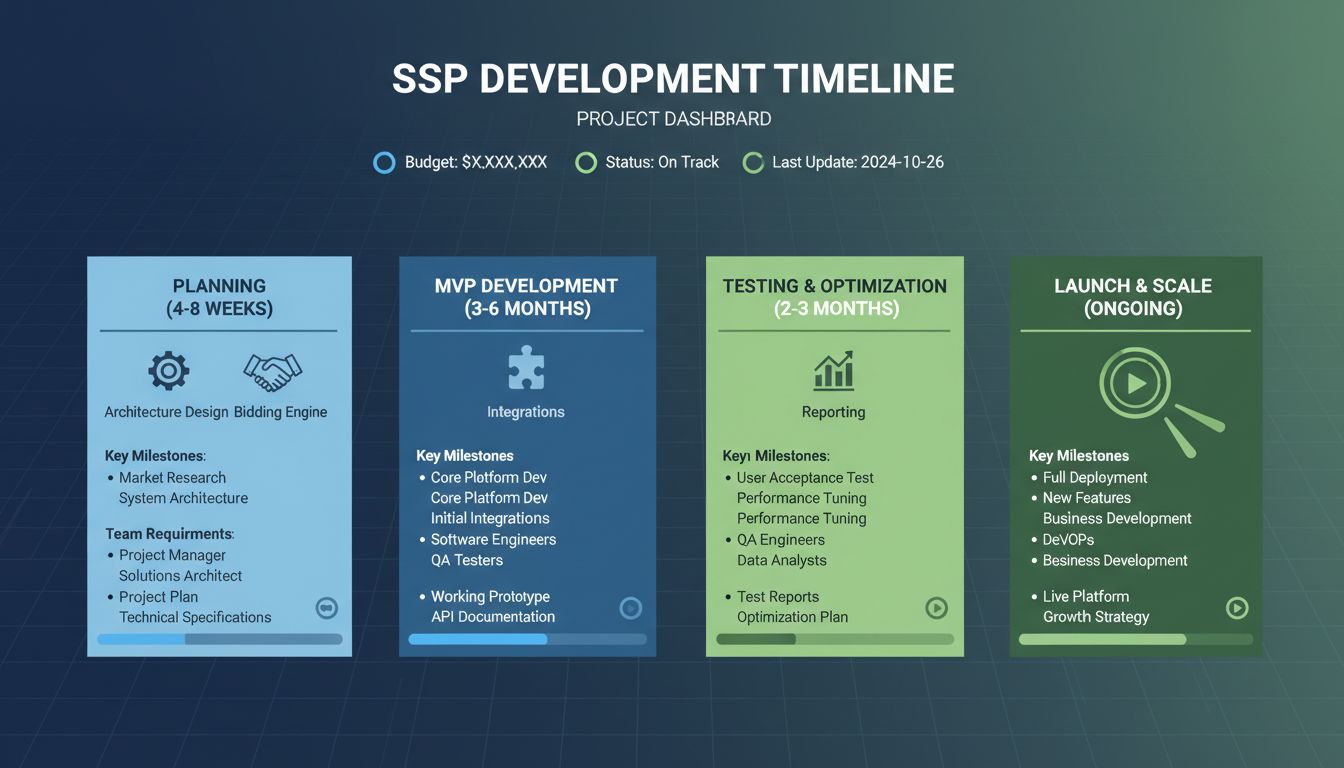
Building a supply side platform from scratch typically takes 1-2 years of development, with initial planning requiring 4-8 weeks, MVP development taking 3-6 months, and testing/optimization requiring 2-3 months. The exact timeline depends on platform complexity, team size, required integrations, and feature scope.
Building a supply side platform (SSP) from scratch is a significant undertaking that requires careful planning, substantial resources, and realistic expectations about timelines. The development process is not a simple linear progression but rather a complex, multi-phase project that involves numerous technical, operational, and strategic considerations. Organizations considering this investment must understand that the timeline can vary dramatically based on platform complexity, team expertise, integration requirements, and business objectives. The industry consensus indicates that a fully functional SSP typically requires between 12 to 24 months of dedicated development effort, though this can extend beyond two years for feature-rich, enterprise-grade solutions.
The initial planning phase is critical and should not be rushed, despite the temptation to begin coding immediately. During this period, your team must establish clear business objectives, define the scope of features, and design the technical architecture that will support your SSP’s operations. This phase involves conducting market research, analyzing competitor platforms, and determining which features are essential for your target market. Your product team should document the mission, set realistic KPIs, and establish success metrics that will guide development decisions throughout the project lifecycle. The planning phase also includes budget allocation, with organizations typically needing to commit $1.5-2.5 million annually for development infrastructure, salaries, and operational costs. This foundational work prevents costly mistakes later and ensures all stakeholders have aligned expectations about the project’s direction and resource requirements.
The Minimum Viable Product (MVP) phase focuses on delivering core functionality that proves the platform’s value proposition without attempting to build every feature at launch. During this critical period, your development team should prioritize the real-time bidding (RTB) bidder engine, basic campaign management interface, pacing engine for budget control, and fundamental reporting capabilities. The MVP should support integration with one or two high-liquidity ad exchanges to validate the core business model and generate initial revenue. This phase typically requires 2-4 backend/RTB engineers, 1-2 data engineers, 1 frontend developer, and 1-2 DevOps specialists working in parallel. The MVP approach allows organizations to test assumptions, gather user feedback, and identify technical challenges early in the development cycle. Many successful SSP implementations have demonstrated that a focused MVP can be deployed within 3-6 months, providing valuable market validation before investing in additional features and integrations.
Once the MVP is functional, rigorous testing becomes essential to ensure reliability, performance, and regulatory compliance. This phase involves load testing to simulate thousands of requests per second, accuracy testing to verify bid logic and reporting alignment, fraud detection validation, and comprehensive privacy compliance checks. Your team must integrate Consent Management Platforms (CMPs) for GDPR and CCPA compliance, implement anti-fraud mechanisms, and conduct Data Protection Impact Assessments (DPIAs). Performance optimization during this phase focuses on achieving latency targets below 200 milliseconds for bid responses, ensuring competitive performance in real-time auctions. Testing should include integration testing with multiple ad exchanges, verification of creative delivery across different formats, and validation of reporting accuracy against actual auction outcomes. This phase typically requires 2-3 months of dedicated effort and involves QA specialists, compliance consultants, and senior engineers working to identify and resolve issues before production launch.
The launch phase marks the beginning of operational deployment, but it is not the end of development. After going live, your team must continuously monitor performance metrics, optimize bidding algorithms, expand exchange integrations, and add new features based on market demands and user feedback. Organizations should expect to allocate ongoing resources for maintenance, security updates, fraud prevention enhancements, and compliance with evolving regulations. The scaling phase involves expanding from initial exchange partnerships to a broader network of demand sources, implementing advanced machine learning models for bid optimization, and adding support for new ad formats like connected TV (CTV) and audio advertising. Many organizations underestimate the ongoing operational costs, which can rival or exceed initial development expenses. Continuous optimization ensures your SSP remains competitive and delivers maximum value to publishers.
| Development Phase | Duration | Team Size | Estimated Cost | Key Deliverables |
|---|---|---|---|---|
| Planning & Architecture | 4-8 weeks | 3-5 people | $150,000-$250,000 | Technical specs, roadmap, budget plan |
| MVP Development | 3-6 months | 8-12 people | $600,000-$1,200,000 | Core bidder, UI, basic reporting |
| Testing & Optimization | 2-3 months | 6-10 people | $300,000-$600,000 | Compliance, performance validation |
| Launch & Initial Scale | 3-6 months | 10-15 people | $500,000-$1,000,000 | Production deployment, monitoring |
| Total First Year | 12-23 months | Varies | $1.5-3.0 million | Fully operational SSP |
The financial investment required to build an SSP from scratch is substantial and represents a significant commitment that only organizations with substantial ad spending budgets can justify. Industry benchmarks suggest that unless your organization has annual ad spending exceeding $50 million, the economics of building your own SSP may not work out favorably compared to alternative solutions. The baseline operating costs include developer salaries ($400,000+ annually for a lean senior team), cloud infrastructure and data storage ($3,500+ monthly for campaign data alone), and ongoing maintenance and compliance expenses. Organizations must also account for hidden costs such as recruiting specialized talent, retention bonuses for key engineers, and the opportunity cost of diverting resources from other business initiatives.
Building an SSP successfully requires assembling a specialized team with deep expertise in programmatic advertising, real-time bidding protocols, distributed systems, and machine learning. Your team should include a Head of Programmatic/Product, 2-4 backend/RTB engineers with OpenRTB experience, 1-2 data engineers familiar with streaming platforms like Kafka, 1 ML/optimization engineer, 1 frontend developer, 1-2 DevOps/SRE specialists, and 1-3 ad operations professionals. One of the most significant challenges organizations face is underestimating the time and effort required for integration work. Connecting to major ad exchanges like Google AdX, PubMatic, OpenX, and Amazon requires extensive engineering effort, technical certifications, and ongoing maintenance. Additionally, implementing ads.txt verification, header bidding support, and fraud detection mechanisms adds substantial complexity to the development timeline.
Many organizations have discovered that the biggest hidden cost is miscalculating how much time and effort will be required to achieve feature parity with established competitors. The programmatic advertising landscape is dominated by a few giants—the top 5 DSPs capture approximately 78% of all available impressions—which means a new SSP may struggle to achieve sufficient liquidity and publisher adoption unless it can quickly match scale and publisher connections. Real-world examples demonstrate that companies like Vodafone have abandoned in-house SSP development plans after encountering the true scope of required investment and complexity. The competitive pressure from established platforms, combined with the rapid evolution of ad tech standards and regulations, means that development timelines often extend beyond initial projections.
Given the substantial time and resource requirements for building an SSP from scratch, many organizations are exploring alternative approaches that offer faster time-to-market and lower initial investment. White-label SSP solutions provide a middle ground between building completely in-house and using a third-party platform, allowing organizations to rebrand and customize an existing platform in weeks rather than years. This approach eliminates the multi-year development cycle while still providing significant customization capabilities and control over the product roadmap. White-label solutions typically cost significantly less than building from scratch, with deployment possible in 2-3 weeks compared to 12-24 months for custom development.
Another viable alternative is outsourcing to specialized AdTech development firms that have existing expertise and accelerated development frameworks. These firms can leverage pre-built components, established architectural patterns, and experienced teams to significantly reduce development timelines. Organizations can also consider a hybrid approach, starting with a white-label solution and gradually building custom components as their business grows and specific requirements become clearer. This phased approach allows organizations to enter the market quickly, validate their business model, and make informed decisions about future investment in custom development.
Organizations considering SSP development must carefully evaluate whether the investment aligns with their business objectives and financial capacity. The realistic timeline of 12-24 months, combined with annual costs of $1.5-3.0 million, means that only organizations with substantial ad spending budgets and long-term strategic commitments should pursue custom development. The development process requires assembling specialized teams with deep programmatic advertising expertise, implementing complex technical architectures, and maintaining continuous investment in optimization and compliance. For most organizations, exploring white-label solutions or partnering with experienced AdTech development firms offers a more practical path to launching an SSP quickly and cost-effectively. The decision to build, buy, or partner should be based on a thorough analysis of business requirements, available resources, competitive positioning, and long-term strategic goals.
Don't spend years building complex infrastructure. PostAffiliatePro provides enterprise-grade affiliate management with proven results. Get started in days, not years.
The supply-side platform, also called the sell-side platform, enables web publishers to manage their ad campaigns, optimize ad revenue, and connect with multipl...
Learn what supply side platforms do, how SSPs work in programmatic advertising, and why they're essential for publisher revenue optimization. Complete technical...
Discover how SSPs generate revenue through commission fees, transaction charges, premium services, and data monetization. Learn the complete SSP revenue model f...
Join our community of happy clients and provide excellent customer support with Post Affiliate Pro.



Cookie Consent
We use cookies to enhance your browsing experience and analyze our traffic. See our privacy policy.