PageRank: Measuring Website Authority
Learn how Google's PageRank algorithm measures website authority by evaluating link quality and quantity. Discover its impact on SEO, affiliate marketing, and h...
4 min read
SEO
AffiliateMarketing
+3

Discover the current importance of Google PageRank in 2025. Learn how PageRank works, its evolution, and why it still matters for SEO rankings and affiliate marketing success.
PageRank remains an important but less dominant factor in Google's ranking algorithm. While it's no longer the sole determinant of rankings, the principle behind it—that links from high-quality sites indicate authority—is still integral to Google's ranking system. Google now uses hundreds of other ranking factors, so a strong PageRank is helpful but not enough on its own to ensure top rankings.
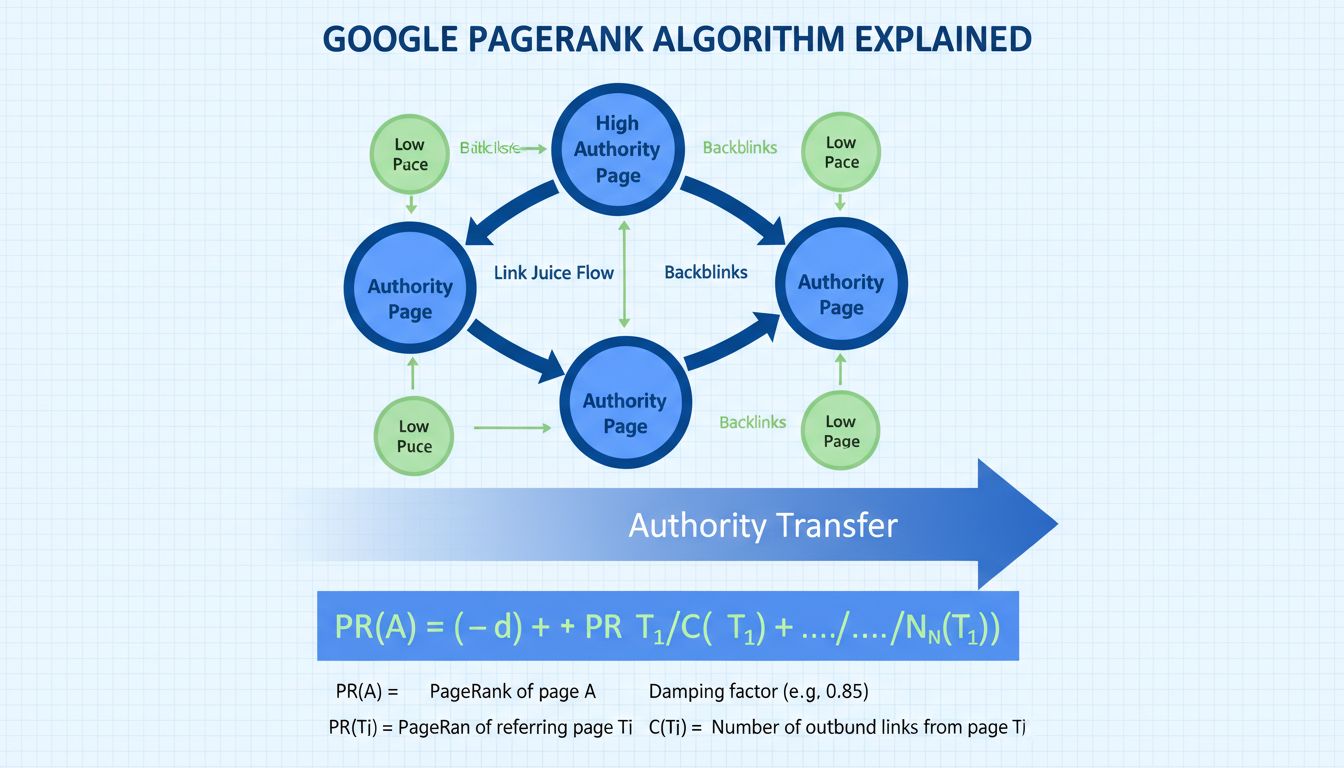
PageRank is a Google algorithm developed by Larry Page and Sergey Brin in 1996 that measures webpage importance based on the quality and quantity of incoming links. Despite being one of Google’s oldest algorithms, PageRank remains relevant in 2025, though its role has evolved significantly. The algorithm treats links as “votes,” where a link from a more authoritative page counts more than a link from a less authoritative one. This foundational concept continues to influence how Google determines which pages are most useful and relevant to search queries.
The importance of PageRank cannot be overstated in the context of SEO history and current practices. When Google first introduced the PageRank Toolbar in 2000, it provided a public score from 0 to 10 that SEOs could view for any webpage. This transparency led to widespread adoption of link-building strategies focused on acquiring high PageRank links. However, Google retired the public PageRank display in 2016 because webmasters became too focused on gaming the metric rather than creating quality content. Despite this removal from public view, internal evidence from leaked Google API documents in March 2024 confirms that multiple versions of PageRank continue to operate within Google’s ranking system.
PageRank operates on a principle called “link equity” or “link juice,” which describes how authority flows through the web’s link structure. When a high-authority page links to another page, it passes a portion of its authority to that page. This transfer is not equal across all links on a page; instead, the authority is distributed among all outgoing links. A page that links to ten different sites will pass less authority to each individual link than a page that links to only two sites. This distribution mechanism encourages websites to be selective about their outlinks and rewards pages that receive links from authoritative sources.
The calculation of PageRank involves complex mathematical formulas that consider the entire web’s link structure. Originally, PageRank used a logarithmic scale with a base of five, meaning each increase in score represented a multiple increase in importance. For example, a page with PageRank 4 could be approximately 25 times more important than a page with PageRank 2. This exponential relationship meant that acquiring links from high-authority pages was exponentially more valuable than acquiring many links from low-authority pages. The algorithm also incorporated the concept of the “reasonable surfer,” which recognizes that not all links are equally likely to be clicked, with links in prominent page positions carrying more weight than those in footers or sidebars.
| Factor | Impact on PageRank | Current Relevance |
|---|---|---|
| Quality of Backlinks | High - Links from authoritative sites pass more authority | Critical - Still primary ranking signal |
| Quantity of Backlinks | Medium - More links help but quality matters more | Important but secondary to quality |
| Anchor Text | Medium - Relevant anchor text provides context | Moderate - Manipulation is penalized |
| Internal Linking Structure | High - Distributes authority across site pages | Critical - Affects page hierarchy and crawlability |
| Link Placement | Medium - Links in main content carry more weight | Important - Footer and sidebar links less valuable |
| Nofollow Attributes | Low - Originally passed no authority, now treated as hints | Low - Google may pass authority through nofollow links |
| Domain Authority | High - Established domains pass more authority | Critical - Domain reputation affects all pages |
The quality versus quantity distinction remains one of PageRank’s most important principles in 2025. A website with fifty low-quality backlinks from spammy directories will rank lower than a website with five high-quality backlinks from industry-leading publications. This principle has shaped modern SEO practices and continues to influence how search engines evaluate website authority. Google’s algorithm now penalizes websites that engage in link schemes, including buying links, participating in link exchanges, or using automated link-building tools. These penalties exist precisely because PageRank principles make link manipulation an attractive but ultimately harmful strategy.
Internal linking structure plays a crucial role in how PageRank flows through a website. The homepage typically accumulates the most authority because it receives links from external sources and internal pages. By strategically linking from the homepage to important internal pages, webmasters can distribute authority throughout their site. Pages with no internal links pointing to them, called “orphaned pages,” receive no authority transfer from the homepage and may struggle to rank. A well-designed internal linking structure ensures that valuable authority reaches all important pages and that the site’s hierarchy reflects content importance.
PageRank’s journey from a transparent public metric to a hidden internal algorithm reveals important lessons about SEO and search engine evolution. When Google first introduced the PageRank Toolbar, it democratized access to information about website authority. SEOs could immediately see which pages Google considered important and adjust their strategies accordingly. However, this transparency created perverse incentives. Webmasters began obsessing over PageRank scores, leading to widespread link manipulation, paid link schemes, and the emergence of link brokers who sold high-PageRank links to the highest bidder. By 2006, Google recognized that the public PageRank metric had become more of a liability than an asset.
The original PageRank patent, filed in September 1998, expired in 2018, but Google had already moved beyond the original algorithm. A 2006 patent on “seed sets” and “trusted seed sites” suggested that Google had evolved its approach to incorporate concepts of trust and authority from established, high-quality websites. These seed sites, such as The New York Times or major educational institutions, serve as anchors for the algorithm. Pages closer to these trusted seed sites in the link graph receive higher authority scores. This evolution made the algorithm more resistant to manipulation because it became harder for new or low-quality sites to artificially boost their authority through link schemes.
The March 2024 leak of Google’s internal API documentation provided unprecedented insight into PageRank’s continued importance. The leaked documents revealed multiple PageRank versions still in use: RawPageRank (basic link-based calculation), PageRank2 (an updated version), PageRank_NS or “nearest seed” (measuring distance from trusted sites), and FirstCoveragePageRank (authority at the time of first discovery). This evidence definitively proved that despite removing the public metric, Google never abandoned PageRank as a core ranking signal. Instead, the company simply made it invisible to prevent manipulation and evolved the algorithm to be more sophisticated and resistant to gaming.
While PageRank remains important, it now operates as one of hundreds of ranking factors Google considers. In 2017, Google’s Gary Illyes confirmed on social media that after eighteen years, Google was still using PageRank alongside hundreds of other signals. This statement acknowledged that PageRank had become less dominant but remained relevant. Modern Google rankings depend on factors including content quality, user experience signals (Core Web Vitals), mobile-friendliness, page speed, topical relevance, entity recognition, and user satisfaction metrics. A website could have excellent PageRank but still rank poorly if its content is thin, outdated, or provides poor user experience.
The relationship between PageRank and other ranking factors has become increasingly complex. Content quality now acts as a prerequisite for ranking; even with strong PageRank, poor content will not rank well. User experience signals have gained importance, with Google’s Core Web Vitals (Largest Contentful Paint, First Input Delay, and Cumulative Layout Shift) becoming explicit ranking factors. Topical authority and E-E-A-T (Experience, Expertise, Authoritativeness, Trustworthiness) have become critical, especially for YMYL (Your Money Your Life) content. PageRank provides the foundation of authority, but modern SEO requires excellence across multiple dimensions.
For affiliate marketers and those building affiliate programs, understanding PageRank’s continued importance is essential. PostAffiliatePro recognizes that affiliate networks benefit from strong domain authority and strategic link building. The platform’s tracking capabilities help affiliates understand which links drive the most valuable traffic and conversions, enabling data-driven decisions about link placement and partnership quality. By focusing on quality affiliate partnerships and strategic link placement, affiliate programs can build authority that compounds over time, similar to how PageRank accumulates through quality backlinks.
Since Google retired the public PageRank metric, SEOs and webmasters have relied on alternative authority metrics to assess website quality. Semrush’s Authority Score, Moz’s Domain Authority, Ahrefs’ Domain Rating, and Majestic’s Trust Flow all attempt to replicate or estimate PageRank’s principles using publicly available link data. These metrics typically range from 0 to 100 and consider factors including the number of backlinks, the authority of linking domains, and the quality of the link profile. While these third-party metrics do not directly affect Google’s algorithms, they provide valuable insights into relative website authority and competitive positioning.
Authority Score and similar metrics work by analyzing the link graph and applying algorithms similar to PageRank. They count the number of referring domains, analyze the authority of those domains, and calculate a composite score. A website with links from ten high-authority domains will typically score higher than a website with links from one hundred low-authority domains. These metrics also consider factors like spam signals, toxic links, and link velocity (how quickly new links appear). By monitoring these alternative metrics, webmasters can track their authority growth and identify potential link quality issues that might trigger Google penalties.
The importance of monitoring authority metrics extends beyond simple ranking predictions. These metrics help identify link-building opportunities, competitive gaps, and potential penalties. If a website’s authority score drops suddenly, it may indicate that Google has devalued some of its backlinks or applied a manual penalty. Conversely, steady authority growth indicates successful link-building efforts and content quality. For affiliate programs, tracking authority metrics helps identify which affiliate partners are most valuable and which partnerships might pose risks to overall domain authority.
Understanding PageRank’s continued importance has direct implications for SEO strategy in 2025. Rather than chasing PageRank scores, modern SEO professionals should focus on earning high-quality backlinks from relevant, authoritative sources. This means creating content that naturally attracts links, building relationships with industry influencers and publications, and participating in legitimate link-building activities like guest posting, broken link building, and resource page inclusion. The principle remains the same as in PageRank’s early days: quality links from authoritative sources are more valuable than quantity of links from low-quality sources.
Internal linking strategy should reflect PageRank principles by ensuring that important pages receive adequate internal link authority. The homepage should link to key category pages, which should link to important content pages. This hierarchical structure ensures that authority flows to pages that matter most for business objectives. Orphaned pages should be eliminated or integrated into the site’s linking structure. Anchor text should be descriptive and relevant, helping both users and search engines understand page content. However, anchor text should appear natural; over-optimization with exact-match keywords can trigger manipulation penalties.
For affiliate programs specifically, PageRank principles suggest that the quality of affiliate partners matters significantly. An affiliate program with links from ten high-authority, relevant websites will accumulate more authority than a program with links from one hundred low-quality affiliate sites. PostAffiliatePro’s affiliate tracking and management features enable program managers to identify and prioritize high-quality affiliates. By focusing on quality partnerships and providing affiliates with tools to create valuable content, affiliate programs can build authority that benefits all participants. The platform’s transparent tracking ensures that high-performing affiliates receive appropriate recognition and compensation, encouraging continued quality contributions.
As search engines continue to evolve, PageRank’s fundamental principle—that links represent endorsements and indicate authority—remains valid. However, the algorithm will likely continue to incorporate additional signals and become more sophisticated at distinguishing genuine endorsements from manipulative links. Artificial intelligence and machine learning are increasingly used to detect link manipulation patterns and identify natural link profiles. Future versions of PageRank may incorporate user behavior signals, content quality assessments, and entity relationships to provide more nuanced authority calculations.
The rise of AI-generated content and synthetic links presents new challenges for PageRank-based ranking systems. Google must distinguish between genuine editorial links and links generated by AI or purchased through link schemes. The company has already begun penalizing AI-generated content that lacks original value and links from low-quality AI-generated pages. As these challenges evolve, PageRank will likely remain relevant but will be supplemented by additional signals that verify content quality and link authenticity. Webmasters should prepare for a future where link quality assessment becomes even more sophisticated and where authority accumulation requires genuine value creation rather than link manipulation.
For businesses building affiliate programs or pursuing SEO strategies, the lesson is clear: focus on creating genuine value that attracts natural links and builds real authority. Short-term link manipulation tactics may provide temporary ranking boosts but ultimately harm long-term success. PostAffiliatePro’s approach to affiliate management aligns with these principles by emphasizing transparent tracking, fair compensation, and quality partnerships. By building affiliate programs on foundations of quality and trust, businesses can accumulate authority that compounds over time and provides sustainable competitive advantages in search rankings.
PostAffiliatePro helps you build a powerful affiliate network with transparent tracking and authority-building features. Manage your affiliate program's link profile and authority metrics with advanced tools designed for modern SEO.
Learn how Google's PageRank algorithm measures website authority by evaluating link quality and quantity. Discover its impact on SEO, affiliate marketing, and h...
Learn how Google PageRank algorithm works in 2025. Understand link analysis, the PageRank formula, damping factor, and how it impacts your affiliate marketing s...
Learn what link juice is in SEO, how it works, and why it matters for rankings. Discover how link equity flows through dofollow links and impacts your website's...
Join our community of happy clients and provide excellent customer support with Post Affiliate Pro.