
Why Are Meta Tags Important for Affiliate Marketing?
Discover why meta tags are crucial for affiliate marketing success. Learn how title tags, meta descriptions, and robots tags improve SEO rankings, boost click-t...
9 min read

Learn how ETag and Last-Modified HTTP headers optimize caching efficiency, reduce bandwidth consumption, and accelerate page rendering in affiliate management systems. Comprehensive guide to conditional requests and cache validation in 2025.
ETag and Last-Modified headers are HTTP response headers that help browsers identify whether cached content has changed. ETags are unique identifiers for specific resource versions, while Last-Modified indicates when content was last updated. Both enable conditional requests that return 304 Not Modified responses instead of re-downloading unchanged content, significantly reducing bandwidth usage and improving page load times in affiliate panels and web applications.
ETag and Last-Modified headers are fundamental components of HTTP’s caching mechanism that work together to optimize web performance and reduce unnecessary data transfers. These response headers enable browsers and servers to communicate about resource freshness, allowing intelligent cache validation without requiring full content re-downloads. In the context of affiliate management systems like PostAffiliatePro, implementing these headers correctly can dramatically improve the responsiveness of affiliate panels, reduce server load, and enhance the overall user experience for thousands of concurrent users tracking commissions and sales data.
An ETag (Entity Tag) is a unique identifier assigned by the server to a specific version of a resource. Think of it as a digital fingerprint that changes whenever the resource’s content changes. The server generates this identifier, typically using a hash algorithm like MD5 or SHA-1 applied to the resource’s content, ensuring that even minor modifications result in a completely different ETag value. When a browser requests a resource, the server includes the ETag in the response header, and the browser stores this value along with the cached content.
The ETag header can be either strong or weak. A strong ETag (formatted as "675af34563dc-tr34") guarantees byte-for-byte identical content, making it suitable for scenarios requiring precise validation like resuming downloads or preventing mid-air collisions during concurrent edits. A weak ETag (formatted as W/"0815") indicates that the resource is semantically equivalent but may have minor differences, such as different timestamps or advertisements, making it ideal for general caching purposes where exact byte-matching isn’t critical.
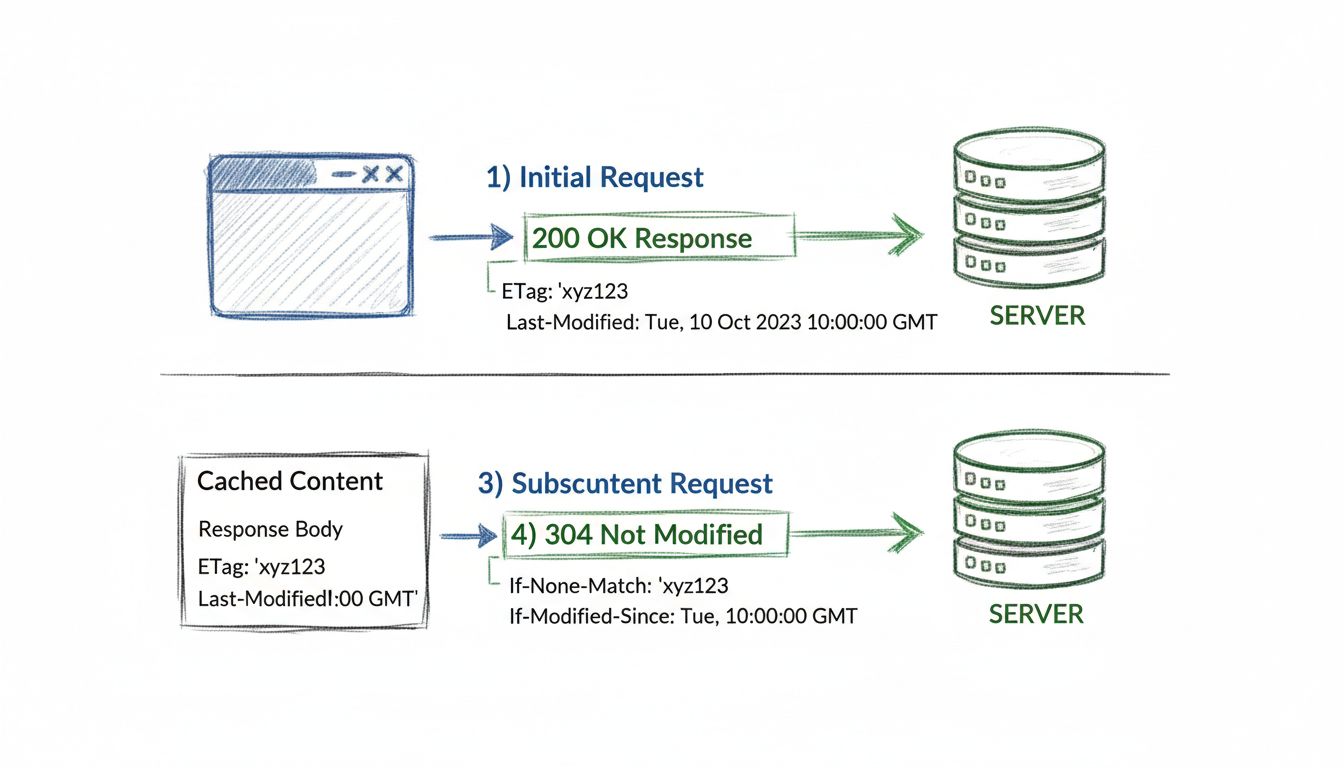
When a cached resource becomes stale, the browser doesn’t immediately discard it. Instead, it sends a conditional request with the If-None-Match header containing the stored ETag value. The server compares this ETag with the current version’s ETag. If they match, the server responds with a 304 Not Modified status code and an empty body, signaling the browser to use its cached version. If the ETags differ, the server sends the full resource with a 200 OK status code, allowing the browser to update its cache.
The Last-Modified header contains a timestamp indicating when the origin server last modified the resource. This header uses the HTTP date format (e.g., Wed, 21 Oct 2025 07:28:00 GMT) and provides a simpler alternative to ETags for cache validation. While less precise than ETags, Last-Modified headers are easier to implement on servers, especially for static content like images, stylesheets, and JavaScript files where modification times are readily available from the file system.
When a browser’s cached resource becomes stale, it sends a conditional request with the If-Modified-Since header containing the Last-Modified timestamp from the previous response. The server checks whether the resource has been modified since that timestamp. If the resource hasn’t changed, the server responds with a 304 Not Modified status. If the resource has been modified, the server sends the complete updated resource with a 200 OK status and a new Last-Modified timestamp.
The Last-Modified header is particularly useful for content management systems and affiliate platforms where tracking modification times is straightforward. However, it has limitations: it only provides second-level precision, and determining the “last modified” time for dynamically generated content can be challenging. Additionally, if a resource is modified and then reverted to its original state, the Last-Modified timestamp changes even though the content is identical, potentially causing unnecessary re-downloads.
| Aspect | ETag | Last-Modified |
|---|---|---|
| Generation Method | Content hash or version number | File system timestamp |
| Precision | Byte-level (strong) or semantic (weak) | Second-level |
| Complexity | More complex to implement | Simpler to implement |
| Dynamic Content | Excellent for dynamic content | Challenging for dynamic content |
| Bandwidth Efficiency | Highly efficient with weak validation | Efficient for static content |
| Collision Handling | Prevents mid-air collisions | Limited collision prevention |
| Cache Busting | Automatic with content changes | Requires timestamp updates |
| Server Load | Minimal (hash comparison) | Minimal (timestamp comparison) |
Conditional requests form the backbone of efficient HTTP caching. The process begins when a browser first requests a resource. The server responds with a 200 OK status, including the full resource content along with validator headers (ETag and/or Last-Modified). The browser stores both the content and these validators in its cache, along with cache control directives that specify how long the content remains fresh.
As long as the cached content is considered fresh (based on Cache-Control directives like max-age), the browser uses the cached version without making any server requests. However, once the cache becomes stale, the browser doesn’t immediately discard the cached content. Instead, it performs a conditional request by sending the stored validator values to the server. For ETag validation, the browser includes the If-None-Match header with the stored ETag value. For Last-Modified validation, it includes the If-Modified-Since header with the stored timestamp.
The server receives this conditional request and compares the provided validators with the current resource state. If the validators match (indicating the resource hasn’t changed), the server responds with a 304 Not Modified status code and an empty response body. This response tells the browser that its cached version is still valid and can be used. The browser then resets the cache freshness timer based on the new Cache-Control headers in the 304 response. If the validators don’t match (indicating the resource has changed), the server sends a 200 OK response with the complete updated resource, allowing the browser to update its cache.
In affiliate management systems like PostAffiliatePro, implementing ETag and Last-Modified headers provides substantial performance improvements. Affiliate panels typically display real-time commission data, sales metrics, and performance dashboards that users refresh frequently. Without proper caching headers, each refresh would require downloading the entire HTML page, CSS stylesheets, JavaScript files, and image assets, even if only the dynamic data has changed.
With ETag and Last-Modified headers properly configured, static resources like stylesheets, JavaScript libraries, and images are cached efficiently. When an affiliate refreshes their dashboard, the browser sends conditional requests for these static assets. The server quickly responds with 304 Not Modified for unchanged resources, consuming minimal bandwidth and server resources. Only the dynamic content (commission data, sales figures) needs to be re-fetched and rendered, resulting in dramatically faster page load times.
This optimization becomes increasingly valuable as the number of concurrent users grows. Each 304 response consumes far fewer server resources than a full 200 response with complete content. For a platform serving thousands of affiliates, this difference translates to significantly reduced server load, lower bandwidth costs, and improved scalability. Additionally, faster page load times enhance user experience, reduce bounce rates, and increase engagement with the affiliate platform.
Implementing ETag and Last-Modified headers effectively requires careful consideration of your application architecture. For static content, most web servers (Apache, Nginx, IIS) automatically generate ETags and Last-Modified headers based on file content and modification times. However, for dynamic content generated by applications, developers must implement custom logic to generate appropriate validators.
When generating ETags for dynamic content, consider using a hash of the response body combined with relevant parameters. For example, an affiliate dashboard might generate an ETag based on the hash of the user’s commission data, ensuring that the ETag changes only when the actual data changes. Avoid including timestamps in ETags for dynamic content, as this defeats the purpose of caching by creating new ETags even when content hasn’t meaningfully changed.
For Last-Modified headers on dynamic content, use the timestamp of the most recent data modification rather than the current server time. This approach allows browsers to cache responses effectively. Additionally, always include both ETag and Last-Modified headers when possible, as different clients may prefer different validation methods. Some older clients or proxies may not support ETags, making Last-Modified a valuable fallback mechanism.
Configure appropriate Cache-Control headers alongside validators. Use Cache-Control: public, max-age=3600 for resources that can be cached for extended periods, and Cache-Control: private, max-age=300 for user-specific content with shorter freshness windows. This combination ensures that browsers validate cached content at appropriate intervals while maximizing cache hit rates.
Weak vs. Strong Validation: Choose weak ETags for general caching scenarios where semantic equivalence is acceptable, such as HTML pages with minor formatting variations. Use strong ETags for critical operations like resuming downloads or preventing concurrent update conflicts. The If-Match header with strong ETags provides optimistic locking, preventing lost updates when multiple clients edit the same resource simultaneously.
Cache Busting Strategies: When deploying new versions of static assets, implement cache busting by including version numbers or content hashes in filenames (e.g., app-v2.3.1.js or style-a1b2c3d4.css). This approach ensures that browsers fetch new versions while maintaining long cache expiration times for versioned assets. ETags automatically handle cache busting for dynamic content by changing whenever content changes.
Proxy and CDN Considerations: Content Delivery Networks (CDNs) and proxy servers also respect ETag and Last-Modified headers. When a CDN edge server receives a request for cached content, it can validate freshness with the origin server using conditional requests, reducing origin server load while maintaining content freshness. Ensure that your ETag generation is consistent across all servers in a distributed system, or use Last-Modified timestamps which are more naturally consistent.
Monitor your caching effectiveness using browser developer tools and server logs. The Network tab in browser DevTools shows response status codes: 200 indicates a full download, 304 indicates a successful conditional request, and 304 responses should significantly outnumber 200 responses for static content. Server logs reveal cache hit rates and bandwidth savings. Tools like Google PageSpeed Insights and WebPageTest provide detailed caching analysis and recommendations.
Track metrics like average response time, bandwidth consumption per user session, and server CPU utilization. Properly implemented ETag and Last-Modified headers should reduce these metrics by 30-60% for typical web applications. In affiliate platforms with high user concurrency, the improvements are often even more dramatic, as conditional requests consume minimal server resources compared to full content delivery.
ETag and Last-Modified headers are essential HTTP mechanisms that enable efficient caching and conditional request validation. ETags provide precise content-based validation suitable for dynamic content and concurrent update scenarios, while Last-Modified headers offer simpler timestamp-based validation ideal for static resources. Together, these headers enable browsers to validate cached content without re-downloading unchanged resources, resulting in faster page loads, reduced bandwidth consumption, and lower server load.
For affiliate management platforms like PostAffiliatePro, implementing these headers correctly is crucial for delivering responsive, scalable systems that can handle thousands of concurrent users efficiently. By understanding how these headers work and following implementation best practices, developers can significantly improve application performance and user experience while reducing infrastructure costs.
PostAffiliatePro's advanced caching infrastructure automatically implements ETag and Last-Modified headers to deliver lightning-fast affiliate panel performance. Reduce server load, minimize bandwidth costs, and provide your affiliates with the fastest possible experience.
Discover why meta tags are crucial for affiliate marketing success. Learn how title tags, meta descriptions, and robots tags improve SEO rankings, boost click-t...
Learn how sticky grid headers improve data table usability by keeping column headers visible while scrolling. Discover implementation methods and best practices...
Learn how title tags impact SEO performance, affect search engine rankings, and drive click-through rates. Discover best practices, common mistakes, and optimiz...
Join our community of happy clients and provide excellent customer support with Post Affiliate Pro.



Cookie Consent
We use cookies to enhance your browsing experience and analyze our traffic. See our privacy policy.
