
Customer Acquisition vs Retention: Which Should You Prioritize in 2025?
Discover whether to focus on acquiring new customers or retaining existing ones. Learn the cost-effectiveness of retention, ROI metrics, and strategic balance f...
7 min read

Discover why acquiring new customers costs 5-25x more than retention. Learn cost-effective retention strategies to maximize customer lifetime value and boost profitability.
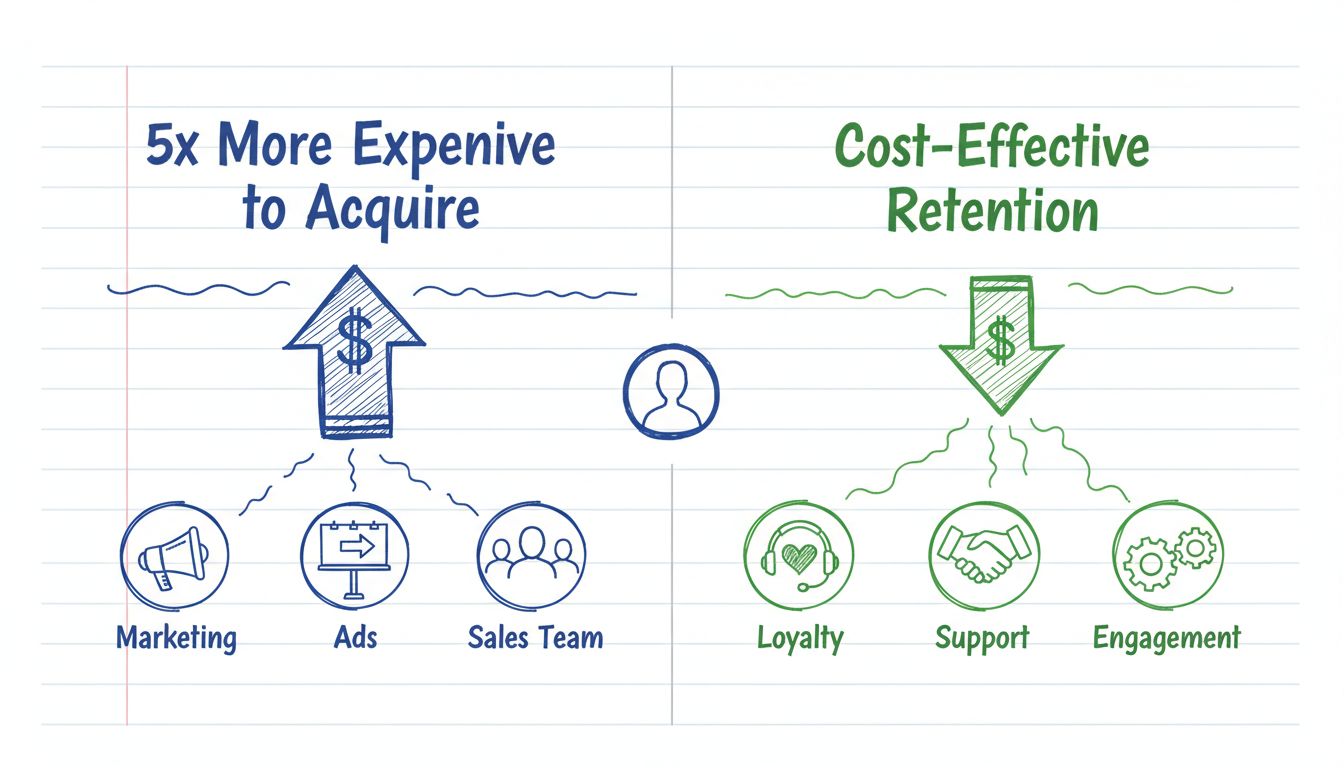
Acquiring a new customer typically costs 5 to 25 times more than retaining an existing one. This significant cost difference makes customer retention strategies far more efficient for boosting long-term revenue and profitability.
The fundamental principle that acquiring a new customer costs significantly more than retaining an existing one has become a cornerstone of modern business strategy. Research from Bain & Company and industry leaders consistently demonstrates that acquiring a new customer can cost between 5 and 25 times more than retaining an existing one. This dramatic difference stems from multiple interconnected factors that directly impact your marketing budget, sales operations, and overall business profitability. Understanding these cost drivers is essential for any business looking to optimize its marketing spend and improve its bottom line.
When acquiring new customers, businesses must invest heavily in various marketing channels to capture attention and generate awareness. This includes digital advertising campaigns across Google Ads, social media platforms like Facebook and Instagram, search engine optimization efforts, content marketing initiatives, and traditional advertising methods. Additionally, companies often need to offer promotional discounts, limited-time offers, and incentives to convert prospects into paying customers. These marketing expenses accumulate quickly, especially when targeting cold audiences with no prior relationship to your brand. The cost per acquisition (CPA) varies significantly by industry, but the investment required to move a prospect through the entire sales funnel—from awareness to consideration to purchase—remains substantial across all sectors.
Acquiring new customers demands considerable time and effort from your sales team. The process involves lead generation, qualification, multiple follow-ups, product demonstrations, negotiations, and closing activities. Each prospect requires personalized attention, customized presentations, and often multiple touchpoints before they commit to a purchase. Sales representatives must invest hours researching prospects, crafting tailored pitches, and addressing objections. In contrast, existing customers are already familiar with your brand, understand your value proposition, and have established trust with your organization. This familiarity dramatically reduces the sales effort required for upselling or cross-selling opportunities, allowing your sales team to focus their energy more efficiently on high-value activities.
New customers typically require extensive onboarding and education to fully understand your product or service and extract maximum value from their purchase. This includes comprehensive training sessions, detailed documentation, video tutorials, one-on-one support calls, and ongoing guidance through the initial implementation phase. Your customer success team must dedicate significant resources to ensure new customers achieve their desired outcomes and become satisfied with their investment. This onboarding phase can extend over weeks or months, depending on product complexity. Existing customers have already completed this learning curve and require minimal educational support, allowing your customer success team to allocate resources more strategically across your customer base.
The success rate of selling to an existing customer is dramatically higher than selling to a new prospect. Research shows that the probability of successfully selling to an existing customer ranges from 60-70%, while the success rate of selling to a new customer is only 5-20%. This substantial difference reflects the power of established relationships, proven trust, and demonstrated value. Existing customers have already experienced the benefits of your product or service and are more likely to make repeat purchases or upgrade to higher-tier offerings. This higher conversion rate means your marketing and sales efforts generate significantly better returns when focused on retention activities compared to acquisition efforts.
The longer a customer remains with your business, the more revenue they contribute over their entire relationship with you. This concept, known as Customer Lifetime Value (CLV), is a critical metric for understanding long-term profitability. A customer who stays with your company for five years generates substantially more revenue than a customer who makes a single purchase and leaves. When you focus on retention strategies, you extend the duration of customer relationships, which directly multiplies the total revenue generated from each customer. This extended relationship also creates opportunities for upselling, cross-selling, and premium service offerings that further increase CLV.
Loyal, satisfied customers become your most effective marketing channel through referrals and word-of-mouth recommendations. Research indicates that loyal customers are 4 times as likely to refer your business to others compared to new customers. These referred customers often have lower acquisition costs because they come pre-qualified through trusted recommendations. Additionally, referred customers typically have higher lifetime values and better retention rates than customers acquired through paid advertising. By investing in retention, you create a virtuous cycle where satisfied customers generate new business at a fraction of the cost of traditional acquisition channels.
| Metric | New Customer Acquisition | Existing Customer Retention |
|---|---|---|
| Relative Cost | 5-25x higher | Baseline (1x) |
| Success Rate | 5-20% | 60-70% |
| Sales Effort Required | High (multiple touchpoints) | Low (established relationship) |
| Onboarding Investment | Extensive (weeks/months) | Minimal (already trained) |
| Marketing Spend | Significant (ads, promotions) | Moderate (email, engagement) |
| Time to Profitability | Extended (months to years) | Immediate (already profitable) |
| Referral Likelihood | Low (5-10%) | High (40%+) |
| Repeat Purchase Rate | Low (5-20%) | High (60-70%) |
Research from industry leaders demonstrates that even modest improvements in customer retention rates generate substantial profit increases. Increasing customer retention by just 5% can increase overall profits by 25-95%, depending on your industry and business model. This dramatic profit multiplication occurs because retained customers generate recurring revenue while requiring lower operational costs. Additionally, U.S. companies lose approximately $136.8 billion annually due to avoidable customer switching, highlighting the enormous financial opportunity available through improved retention strategies.
Tailoring your communications, offers, and experiences to individual customer preferences significantly increases satisfaction and loyalty. By leveraging customer data and behavioral insights, you can deliver personalized product recommendations, customized email campaigns, and targeted offers that resonate with each customer’s specific needs. Personalization demonstrates that you understand and value each customer as an individual, strengthening emotional connections and increasing the likelihood of repeat purchases. Modern affiliate management platforms like PostAffiliatePro enable sophisticated personalization by tracking customer interactions and preferences across multiple touchpoints.
Structured loyalty programs that reward repeat customers with discounts, exclusive offers, points, or premium benefits create powerful incentives for continued business. These programs transform transactional relationships into emotional connections by recognizing and appreciating customer loyalty. Effective loyalty programs encourage customers to increase their purchase frequency and average order value while simultaneously gathering valuable data about customer preferences and behavior. The best loyalty programs align rewards with customer values and provide genuine benefits that customers actively seek.
Providing outstanding customer service throughout the entire customer lifecycle builds trust, satisfaction, and loyalty. Responsive support, knowledgeable representatives, and proactive problem-solving demonstrate your commitment to customer success. When customers encounter issues or have questions, quick and effective resolution reinforces their confidence in your brand. Exceptional service also creates opportunities for positive word-of-mouth recommendations and referrals, extending your reach at minimal cost.
Regular engagement through newsletters, surveys, social media interactions, and personalized communications keeps your brand top-of-mind and maintains strong customer relationships. Consistent, valuable communication demonstrates ongoing commitment to customer success and provides opportunities to share new offerings, industry insights, and relevant information. Strategic engagement prevents customer attrition by maintaining active relationships and identifying potential issues before they lead to customer loss.
The financial evidence overwhelmingly supports prioritizing customer retention alongside acquisition efforts. While acquiring new customers remains important for business growth, the significantly higher costs and lower success rates make retention strategies far more efficient for generating sustainable, profitable growth. By implementing comprehensive retention strategies—including personalization, loyalty programs, exceptional service, and continuous engagement—businesses can dramatically improve their return on marketing investment and accelerate profitability. PostAffiliatePro’s advanced affiliate management platform provides the tools and insights needed to track, manage, and optimize customer relationships for maximum lifetime value and long-term business success.
PostAffiliatePro's advanced affiliate management platform helps you build lasting customer relationships and optimize your retention strategies. Track, manage, and reward your most valuable customers with our comprehensive affiliate software solution.
Discover whether to focus on acquiring new customers or retaining existing ones. Learn the cost-effectiveness of retention, ROI metrics, and strategic balance f...
Learn how to decide between customer acquisition and retention. Assess your customer base size, growth needs, and business model to make the right strategic cho...
Discover proven customer retention strategies including loyalty programs, personalization, community building, and affiliate marketing to boost customer lifetim...
Join our community of happy clients and provide excellent customer support with Post Affiliate Pro.



Cookie Consent
We use cookies to enhance your browsing experience and analyze our traffic. See our privacy policy.
