

What is Click Attribution in Affiliate Marketing?
Learn what click attribution is in affiliate marketing, how different attribution models work, and why accurate tracking matters for your affiliate program succ...
9 min read

Learn how calls to action drive conversions and engagement in affiliate marketing. Discover CTA strategies, best practices, and examples to maximize your affiliate revenue.
A call to action (CTA) is a crucial component in affiliate marketing that guides readers on what to do next—such as signing up, making a purchase, or sharing content. A well-crafted CTA removes ambiguity, creates urgency, and directly influences conversion rates by transforming passive readers into active participants who take the desired action.
A call to action (CTA) is far more than a simple button or phrase—it’s a strategic marketing tool that serves as the bridge between your content and the desired conversion outcome. In affiliate marketing, where the primary goal is to drive sales, leads, or other measurable actions, a well-crafted CTA is absolutely essential to success. Without a clear CTA, even the most compelling content may fail to convert readers into customers, leaving significant revenue on the table. The CTA essentially tells your audience exactly what step to take next, eliminating confusion and friction in the decision-making process.
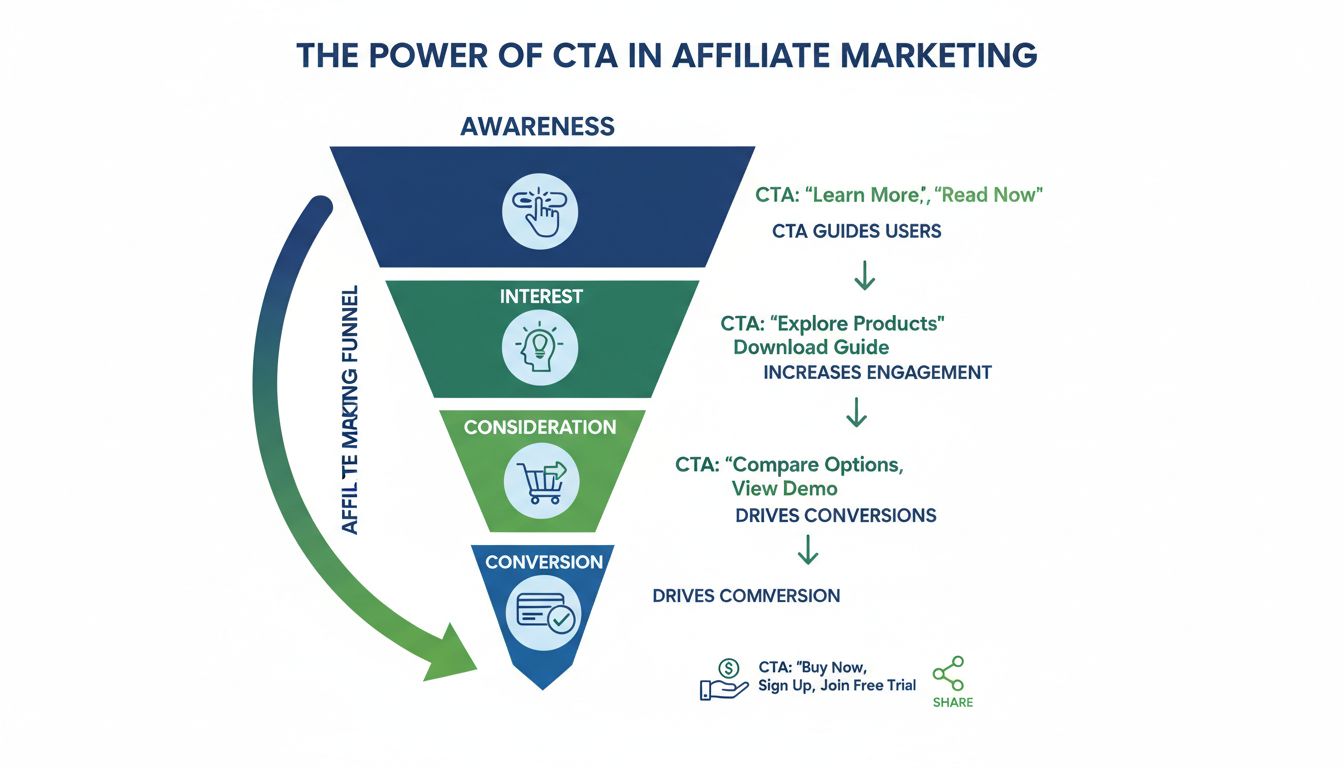
The fundamental purpose of a CTA in affiliate marketing is to guide users through the marketing funnel from awareness to action. When a potential customer reads your product review, comparison article, or promotional content, they may be interested but uncertain about what to do next. A strategic CTA removes this uncertainty by providing explicit instructions—whether that’s clicking an affiliate link to purchase, signing up for a free trial, downloading a resource, or sharing content with their network. This clarity is what transforms passive readers into active participants who take the desired action, ultimately driving conversions and revenue for your affiliate program.
The relationship between CTAs and conversion rates is direct and measurable. Research consistently shows that pages with clear, compelling CTAs experience significantly higher conversion rates than those without them. A CTA works by creating a clear pathway for user action, reducing the cognitive load required for decision-making. When visitors land on your affiliate content, they’re often in a state of consideration—they’re interested but not yet committed. A strategically placed and well-worded CTA provides the final nudge needed to push them toward conversion.
CTAs increase engagement by making the user experience more intuitive and purposeful. Instead of leaving visitors to figure out what to do next, a CTA simplifies the process by narrowing down their options to a single, clear action. This is particularly important in affiliate marketing, where you’re competing for attention and trying to drive clicks to your affiliate links. When a visitor reads your blog post about the best project management software and sees a CTA like “Start Your Free 30-Day Trial,” they immediately understand the next step and are more likely to take it. The engagement doesn’t stop at the click—it extends to the merchant’s website, where the visitor may complete a purchase or sign-up, generating commission for your affiliate program.
| CTA Characteristic | Description | Impact on Conversions |
|---|---|---|
| Clarity | Uses straightforward language that leaves no room for interpretation | Reduces confusion and hesitation |
| Action Verbs | Starts with strong verbs like “Shop,” “Subscribe,” “Claim,” “Discover” | Prompts immediate engagement |
| Urgency | Incorporates time-sensitive language like “Limited Time” or “Today Only” | Encourages immediate action rather than procrastination |
| Value Proposition | Clearly communicates the benefit of taking action | Motivates users by showing what they’ll gain |
| Visibility | Stands out visually through color, size, or placement | Ensures users notice and consider the CTA |
| Relevance | Aligns with the content and user’s current stage in the funnel | Feels natural and appropriate to the context |
| Scarcity | Uses phrases like “Only 3 Spots Left” or “Exclusive Access” | Triggers fear of missing out (FOMO) |
| Personalization | Tailored to specific audience segments or user behavior | Increases relevance and resonance |
An effective CTA in affiliate marketing must be crystal clear about what action the user should take. Vague language like “Click here” or “Learn more” without context fails to communicate the specific benefit or action. Instead, use action-oriented language that tells users exactly what will happen when they click. For example, “Get 20% Off Your First Order” is far more compelling than “Click here” because it clearly communicates both the action and the benefit. The language should also align with your audience’s needs and pain points, speaking directly to what motivates them to take action.
One of the most powerful psychological principles in affiliate marketing is the concept of urgency and scarcity. When users feel that an opportunity is limited or time-sensitive, they’re more likely to act immediately rather than postponing the decision. CTAs can leverage this principle through strategic language choices. Phrases like “Limited-time offer,” “Only 3 spots left,” “Ends tonight,” or “Exclusive access” create a sense of urgency that compels users to take action now. This is particularly effective in affiliate marketing because it reduces the likelihood that users will leave your content, compare other options, and potentially click a competitor’s affiliate link instead.
Scarcity-based CTAs work by tapping into the psychological principle known as FOMO (fear of missing out). When potential customers believe they might miss out on a valuable opportunity, they’re more motivated to act quickly. For instance, a CTA that reads “Claim Your Exclusive 50% Discount—Offer Expires in 24 Hours” creates both urgency and exclusivity, making the user feel like they’re getting a special deal that won’t be available to everyone. In affiliate marketing, this approach can significantly boost click-through rates and conversions, as users are more likely to click your affiliate link when they believe the offer is time-limited or exclusive.
The placement of your CTA is just as important as the CTA itself. Research shows that CTAs perform best when placed at strategic points in your content where users are most likely to be ready to take action. The most common and effective placements include at the end of blog posts, within product reviews, in the middle of longer content (to capture users before they scroll away), and in prominent positions like headers or sidebars. In affiliate marketing, many successful affiliates use multiple CTAs throughout their content—perhaps a subtle one early on and a more prominent one at the end—to capture users at different stages of their decision-making process.
Visual design plays a crucial role in CTA effectiveness. A CTA button should stand out visually from the rest of your content through contrasting colors, appropriate sizing, and strategic whitespace. Studies show that certain colors perform better for CTAs—green and orange typically generate higher click-through rates than other colors, though this can vary depending on your brand and audience. The button should be large enough to be easily clickable on both desktop and mobile devices, and the text should be concise and action-oriented. Additionally, the visual design should be consistent with your brand identity to maintain trust and professionalism. When users see a well-designed CTA that matches your brand aesthetic, they’re more likely to trust it and click through to your affiliate offer.
Different types of CTAs serve different purposes in your affiliate marketing strategy, and understanding when to use each type can significantly improve your results. Direct action CTAs like “Buy Now,” “Shop Today,” or “Get Started” are ideal for product pages and promotional content where you want immediate conversions. These CTAs work best when you’re promoting a specific product or service and want users to take immediate action. Informational CTAs such as “Learn More,” “Read the Guide,” or “Explore Features” are valuable for content that’s designed to educate and build trust before the conversion. These CTAs are particularly useful in affiliate marketing when you’re promoting higher-ticket items or services that require more consideration.
Social sharing CTAs encourage users to share your content with their networks, which can amplify your reach and drive more traffic to your affiliate offers. CTAs like “Share This Review,” “Pin This Guide,” or “Tweet This Tip” can help your content go viral and reach a wider audience. Feedback CTAs such as “Leave a Review” or “Tell Us Your Experience” build community and social proof, which can increase trust and conversions for future visitors. Finally, personalized CTAs that dynamically adjust based on user behavior or preferences—such as “Your Recommended Products” or “Exclusive Offer Just for You”—create a more tailored experience that resonates with individual users and typically generate higher conversion rates than generic CTAs.
To maximize the effectiveness of your CTAs in affiliate marketing, you need to track and measure their performance. Key metrics to monitor include click-through rate (CTR), which measures the percentage of users who click your CTA; conversion rate, which tracks how many clicks result in actual conversions; and cost per conversion, which helps you understand the ROI of your affiliate efforts. By analyzing these metrics, you can identify which CTAs are performing well and which need improvement. A/B testing is essential for CTA optimization—test different variations of your CTA text, colors, placement, and design to see what resonates best with your audience.
PostAffiliatePro provides comprehensive tracking and reporting tools that allow you to monitor CTA performance across all your affiliate campaigns. With detailed analytics, you can see exactly which CTAs are driving the most conversions and which ones need refinement. The platform’s conversion tracking capabilities ensure you have accurate data on which affiliate links and CTAs are generating revenue, enabling you to make data-driven decisions about your marketing strategy. By continuously testing and refining your CTAs based on performance data, you can steadily improve your conversion rates and maximize your affiliate revenue.
Successful affiliate marketers follow several best practices when implementing CTAs. First, ensure your CTA is relevant to the content and user’s current stage in the buying journey. A user reading a product comparison article needs a different CTA than someone reading a beginner’s guide. Second, use clear, action-oriented language that tells users exactly what will happen when they click. Avoid vague phrases and instead be specific about the benefit or action. Third, create a sense of urgency or exclusivity when appropriate, but avoid overusing these tactics as they can damage credibility if overplayed. Fourth, test different variations of your CTAs to identify what works best for your audience—what works for one niche may not work for another.
Fifth, ensure your CTA is visually prominent and easy to find on the page. Users shouldn’t have to search for your CTA or scroll extensively to find it. Sixth, make sure your CTA is mobile-friendly, as an increasing percentage of users access content on mobile devices. A CTA that looks great on desktop but is difficult to click on mobile will result in lost conversions. Finally, maintain consistency across your CTAs and brand messaging. Users should feel confident that clicking your CTA will deliver on the promise made in your content and CTA text. By following these best practices and continuously optimizing based on performance data, you can create CTAs that significantly boost your affiliate marketing conversions and revenue.
PostAffiliatePro provides advanced CTA management, conversion tracking, and affiliate optimization tools to help you create high-performing campaigns. Our platform makes it easy to test, refine, and deploy CTAs that drive real results for your affiliate program.
Learn what click attribution is in affiliate marketing, how different attribution models work, and why accurate tracking matters for your affiliate program succ...
Discover how affiliate marketing enables precise audience targeting through niche networks, demographic segmentation, and performance-based strategies. Learn ad...
Discover essential affiliate marketing analytics to track: CTR, conversion rates, traffic sources, ROI, and more. Learn how to optimize your affiliate strategy ...
Join our community of happy clients and provide excellent customer support with Post Affiliate Pro.



