
How Do I Pay for Paid Search? Complete Guide to PPC Payment Models
Learn how paid search payment works, from setting up billing to understanding cost-per-click (CPC) charges. Discover bidding strategies and payment methods for ...
9 min read

Discover why quality score often matters more than bid in SEM. Learn how Google’s ad auction formula balances bids with quality to determine ad rank and cost efficiency.
While both are crucial, ad quality often takes precedence. Search engines prioritize relevance, ensuring that users see the most pertinent ads, which can sometimes mean lower bids but higher relevance winning the auction.
Search engine marketing operates on a sophisticated real-time auction system that determines which ads appear in search results and their placement positions. When a user enters a search query, search engines like Google instantly evaluate all relevant ads competing for visibility. The critical insight that many advertisers miss is that this auction doesn’t simply reward the highest bidder—instead, it uses a complex formula that weighs multiple factors to ensure users see the most relevant and useful ads. Understanding this mechanism is fundamental to making informed decisions about whether to prioritize bid increases or quality improvements in your SEM strategy.
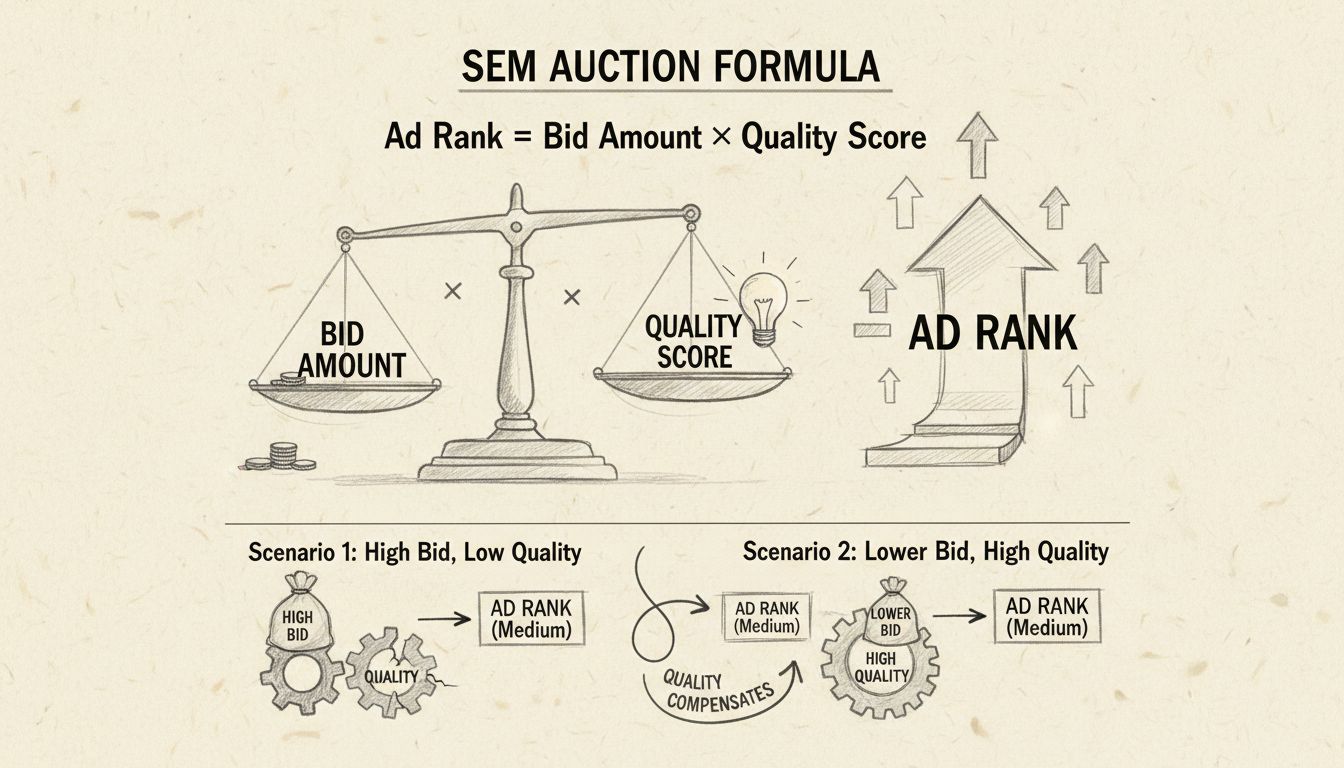
The auction process happens in milliseconds, evaluating hundreds of variables simultaneously. Google’s algorithm considers not just how much you’re willing to pay per click, but also how relevant your ad is to the search query, the quality of your landing page experience, and the expected click-through rate of your ad. This multi-factor approach creates a more level playing field where smaller businesses with well-optimized campaigns can compete effectively against larger competitors with bigger budgets. The formula that determines your ad’s position is straightforward yet powerful: Ad Rank = Bid Amount × Quality Score. This mathematical relationship reveals why quality can be just as important—or even more important—than raw bidding power.
Quality Score is Google’s rating system that measures the relevance and quality of your ads, keywords, and landing pages on a scale of 1 to 10. This metric directly impacts both your ad placement and the cost you pay per click, making it one of the most important factors in SEM campaign performance. A high Quality Score signals to Google that your ad provides genuine value to users searching for specific terms, which aligns perfectly with Google’s primary objective: delivering the best possible search experience. When you achieve a Quality Score of 8 or higher, you unlock significant competitive advantages that can transform your campaign economics.
The three main components that determine your Quality Score are expected click-through rate (CTR), ad relevance, and landing page experience. Expected CTR measures how likely users are to click your ad based on historical performance and competitive context. Ad relevance evaluates how closely your ad copy matches the keywords you’re bidding on and the user’s search intent. Landing page experience assesses whether your destination page is relevant, loads quickly, and provides a seamless user experience. Each of these components carries substantial weight in Google’s algorithm, and improvements in any area can yield measurable results. PostAffiliatePro users who focus on optimizing these Quality Score components consistently report lower cost-per-click rates and higher conversion volumes compared to those who rely primarily on bid increases.
One of the most powerful dynamics in SEM is how a high Quality Score can enable you to achieve top ad positions with significantly lower bids than competitors. This principle fundamentally changes how successful advertisers approach budget allocation and bidding strategy. Consider a practical example: if you have a Quality Score of 9 and bid $5 per click, your Ad Rank would be 45. A competitor with a Quality Score of 5 would need to bid $9 per click to achieve the same Ad Rank of 45. This means you’re getting equivalent placement at 44% lower cost—a substantial advantage that compounds across thousands of clicks and months of campaigns.
This cost efficiency advantage extends beyond just achieving the same position as competitors. When you maintain a high Quality Score, you often achieve better positions at lower costs, creating a virtuous cycle where improved performance metrics lead to better placements, which generate more clicks and conversions, which further improve your Quality Score. The landing page experience component is particularly important here, as it accounts for approximately one-third of your overall Quality Score. Search engines recognize that users who have positive experiences on your landing pages are more likely to return and conduct future searches, which benefits the search engine’s long-term ecosystem. By investing in landing page optimization—ensuring fast load times, mobile responsiveness, clear value propositions, and intuitive navigation—you’re not just improving your Quality Score; you’re creating genuine value for users that search engines reward with better ad placement and lower costs.
While Quality Score often takes precedence, bid strategy remains a critical component of SEM success that cannot be ignored. Your bid amount represents the maximum amount you’re willing to pay per click, and it directly influences your ad’s visibility and position in search results. Understanding when to increase bids and how to do so strategically is essential for scaling successful campaigns and capturing high-value opportunities. The key is to view bid adjustments not as a substitute for quality optimization, but as a complementary strategy that works in concert with Quality Score improvements.
Bid increases are most effective when applied to keywords and ad groups that already demonstrate strong performance metrics. If a keyword is generating clicks and conversions at a healthy cost-per-acquisition, increasing the bid can expand your reach by securing higher ad positions and capturing additional impression share. Conversely, increasing bids on underperforming keywords without first addressing quality issues is typically wasteful and inefficient. Modern SEM platforms offer sophisticated bidding strategies like Target CPA (Cost Per Acquisition), Target ROAS (Return on Ad Spend), and Maximize Conversions that use machine learning to automatically adjust bids based on conversion likelihood. These automated strategies often outperform manual bidding because they can process vast amounts of data and make micro-adjustments in real-time, something human managers cannot replicate at scale.
| Factor | Quality Score Impact | Bid Impact | Optimal Approach |
|---|---|---|---|
| Cost Per Click | Reduces CPC by up to 50% with high QS | Increases CPC directly | Maximize QS first, then adjust bids |
| Ad Position | Improves position without bid increase | Directly improves position | Balance both for optimal placement |
| Long-term Sustainability | Compounds over time as QS improves | Requires continuous spending | Quality provides lasting advantage |
| Competitive Advantage | Creates differentiation vs competitors | Temporary advantage if outbid | Quality creates defensible moat |
| ROI Efficiency | Improves ROI through cost reduction | Improves ROI through volume | Quality optimization yields better ROI |
| Scalability | Scales efficiently as QS improves | Scaling requires proportional budget increase | Quality-first approach scales better |
This comparison reveals a fundamental truth about SEM economics: while bid increases provide immediate, predictable improvements in ad position, Quality Score improvements deliver superior long-term value through cost reduction and competitive advantage. The most successful SEM practitioners understand that these factors work together synergistically. A campaign with a high Quality Score and competitive bid will outperform a campaign with a high bid but low Quality Score. The optimal strategy involves first establishing a strong foundation of quality through ad relevance, keyword alignment, and landing page optimization, then using strategic bid adjustments to fine-tune position and capture additional volume from high-performing keywords.
Improving your Quality Score requires a systematic approach that addresses each component of Google’s evaluation criteria. Start by conducting a comprehensive audit of your existing keywords and ad groups, identifying which ones have Quality Scores below 7. These underperforming keywords represent immediate opportunities for improvement and cost reduction. For each low-scoring keyword, analyze the three quality components: if your expected CTR is low, your ad copy may not be compelling or relevant enough; if ad relevance is poor, your ad text may not match the keyword closely enough; if landing page experience is low, your destination page may not align with user expectations or may have technical issues.
Ad copy optimization is one of the most direct ways to improve Quality Score. Your ad headlines and descriptions should include the target keyword naturally and speak directly to the user’s search intent. If someone searches for “affordable project management software,” your ad should address affordability and project management capabilities explicitly. This relevance signal tells Google that your ad matches the user’s needs, which improves expected CTR and ad relevance scores. Landing page optimization is equally critical—the page users land on after clicking your ad must deliver on the promise made in your ad copy. If your ad emphasizes free trials, the landing page should prominently feature the free trial offer. If your ad highlights specific features, the landing page should explain those features in detail. Additionally, ensure your landing pages load quickly (under 3 seconds on mobile), are mobile-responsive, and have clear calls-to-action that guide users toward conversion.
Keyword selection and grouping also significantly impact Quality Score. Rather than creating large ad groups with dozens of loosely related keywords, organize keywords into tightly themed groups of 5-15 highly related terms. This allows you to write ad copy that’s specifically relevant to each keyword group, improving ad relevance scores across the board. Use exact match and phrase match keywords for better control over relevance, reserving broad match for discovery purposes only. Many successful advertisers using PostAffiliatePro’s tracking capabilities have found that implementing these quality-focused strategies reduces their cost-per-click by 20-40% within 60-90 days, even without increasing their bids.
The financial implications of prioritizing Quality Score over bid increases are substantial and measurable. Consider a campaign with 10,000 monthly clicks at an average CPC of $2.00, resulting in a monthly ad spend of $20,000. If you increase your bid by 20% to improve position, your CPC might increase to $2.40, raising monthly spend to $24,000—a $4,000 increase with uncertain volume gains. Conversely, if you improve your Quality Score from 6 to 8 through optimization, you might reduce your CPC to $1.60 while maintaining or even increasing your click volume due to improved ad position. This would reduce your monthly spend to $16,000 while potentially increasing conversions, creating a win-win scenario that’s impossible to achieve through bid increases alone.
This quality-first approach becomes even more powerful when applied across multiple campaigns and keywords. A business managing 50 keywords across 5 campaigns could potentially save $50,000-$100,000 annually by improving Quality Scores across the board, without reducing ad spend or sacrificing visibility. These savings can be reinvested into higher-performing keywords, expanded keyword lists, or additional marketing channels. The compounding effect of quality improvements means that early investments in optimization yield returns that accelerate over time. As your Quality Scores improve, your cost-per-click decreases, which improves your ROI, which justifies increased budgets, which generates more data for further optimization. This virtuous cycle is one of the most powerful dynamics in SEM, and it’s available to any advertiser willing to prioritize quality over quick bid increases.
The most effective SEM strategy doesn’t choose between quality and bid optimization—it integrates both into a cohesive approach that maximizes performance across all metrics. The optimal sequence is to first establish a strong quality foundation by ensuring your ads are relevant, your keywords are well-organized, and your landing pages deliver excellent user experiences. Once you’ve achieved Quality Scores of 7 or higher across your campaigns, you can then strategically increase bids on your best-performing keywords to capture additional volume and market share. This two-phase approach ensures you’re not wasting budget on bid increases for underperforming keywords while simultaneously building a sustainable competitive advantage through quality.
Advanced SEM practitioners also use bid adjustments strategically based on device type, location, time of day, and audience segments. These granular adjustments allow you to allocate budget more efficiently, bidding higher for high-value segments and lower for segments with lower conversion rates. When combined with high Quality Scores, these sophisticated bidding strategies create a powerful optimization engine that continuously improves campaign performance. PostAffiliatePro’s affiliate tracking capabilities enable you to connect SEM performance data with actual conversion and revenue data, allowing you to make bid and quality optimization decisions based on real business outcomes rather than just click metrics. This data-driven approach transforms SEM from an art into a science, where every optimization decision is backed by measurable evidence of its impact on your bottom line.
Master the balance between bid strategy and quality optimization with PostAffiliatePro's advanced affiliate tracking and campaign management tools. Track quality metrics, optimize your ad spend, and maximize ROI across all your SEM campaigns.
Learn how paid search payment works, from setting up billing to understanding cost-per-click (CPC) charges. Discover bidding strategies and payment methods for ...
Discover how Real-Time Bidding (RTB) can significantly enhance your campaign performance through precise audience targeting, cost optimization, and conversion-d...
Paid search is a popular digital advertising model where advertisers pay only for clicks on their ads, ensuring targeted visibility on search engine results pag...
Join our community of happy clients and provide excellent customer support with Post Affiliate Pro.



Cookie Consent
We use cookies to enhance your browsing experience and analyze our traffic. See our privacy policy.
