How Can I Use Meta Tags for SEO?
Learn how to use meta tags for SEO effectively. Discover essential meta tags like title, description, robots, and Open Graph tags to boost your search rankings ...
11 min read

Discover why meta keywords are outdated and no longer used by Google for ranking. Learn what to focus on instead with modern SEO best practices and alternatives.
No, meta keywords are outdated and not used by Google for ranking purposes. Focus on title tags and meta descriptions instead.
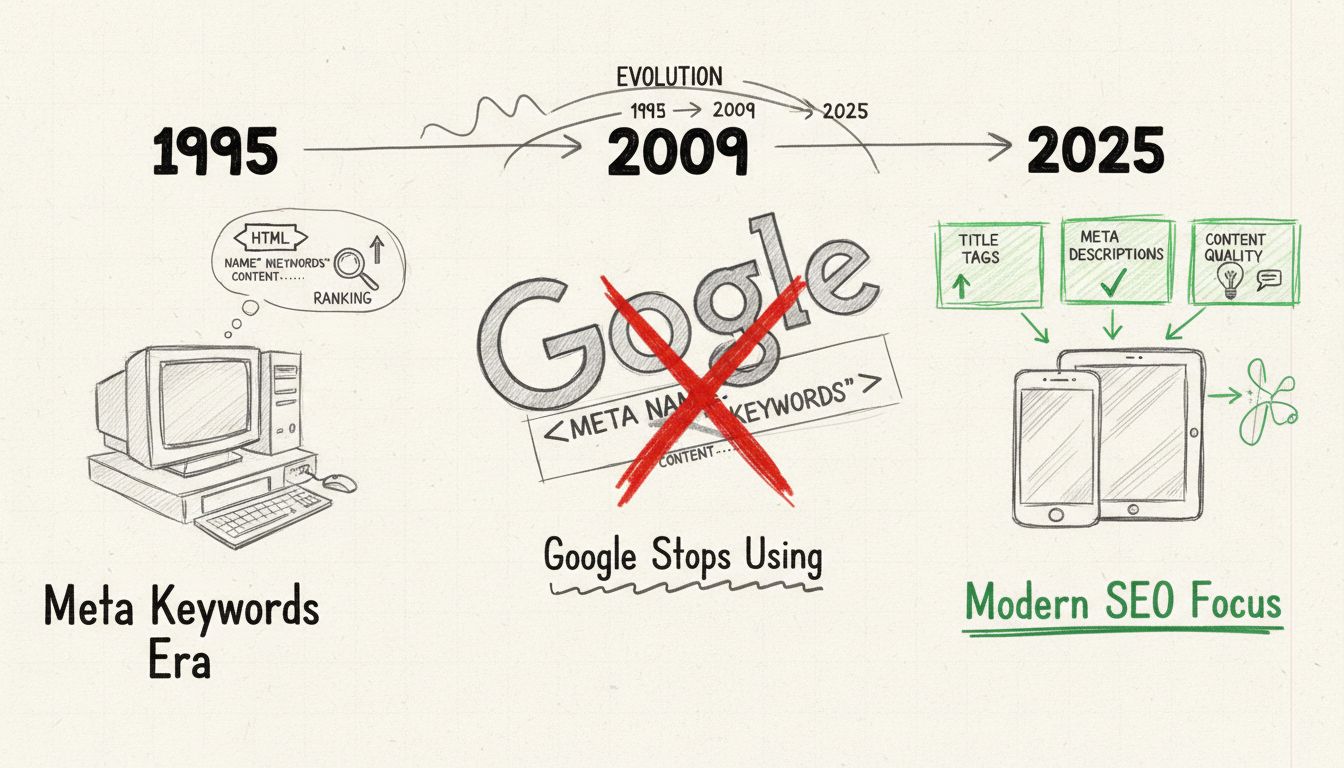
Meta keywords are HTML tags placed in the head section of a webpage’s source code that were originally designed to help search engines understand the topic and content of a page. These tags contained a comma-separated list of keywords that webmasters believed would improve their search engine rankings. The syntax for a meta keywords tag looks like this: <meta name="keywords" content="keyword1, keyword2, keyword3">. When meta keywords were first introduced in 1995, search engines relied heavily on this metadata to categorize and index web pages, making it a critical component of early SEO strategies. However, this reliance on webmaster-provided metadata created a significant vulnerability that would eventually lead to the abandonment of this ranking factor.
The fundamental problem with meta keywords was that they were extremely easy to manipulate and abuse. Webmasters quickly discovered that they could stuff irrelevant keywords into the meta keywords tag to artificially boost their rankings, a practice known as keyword stuffing. This abuse became so widespread that search engines could no longer trust the information provided in these tags. By the early 2000s, major search engines recognized that relying on meta keywords was counterproductive to delivering quality search results to users. The turning point came in 2009 when Google officially announced that it no longer used the meta keywords tag as a ranking factor, effectively ending the era of meta keywords as an SEO tool.
Google’s decision to stop using meta keywords in 2009 was not arbitrary but rather a strategic response to widespread abuse and the evolution of search technology. Matt Cutts, Google’s former Head of the Webspam team, explicitly confirmed that Google “[doesn’t] use the keywords meta tags in [their] search rankings.” This official statement marked the definitive end of meta keywords as a viable SEO tactic. The primary reason for this abandonment was that keyword stuffing had become so prevalent that the meta keywords tag had lost all credibility as a signal of page relevance. Webmasters were listing hundreds of unrelated keywords in hopes of capturing traffic from multiple search queries, which directly contradicted the goal of providing users with relevant search results.
Beyond Google, other major search engines followed suit. Bing, Yahoo, and Baidu have all publicly stated or demonstrated through their algorithms that they do not use meta keywords as a ranking factor. In fact, some search engines like Bing have taken an even more aggressive stance, treating excessive or spammy use of meta keywords as a negative signal that could potentially harm a website’s rankings. This universal rejection of meta keywords across all major search engines reflects a fundamental shift in how search algorithms work. Modern search engines now rely on sophisticated artificial intelligence and machine learning algorithms that analyze actual page content, user behavior, backlinks, and hundreds of other signals to determine relevance and authority. The meta keywords tag, which provides no information about actual page content, has become completely irrelevant to these advanced algorithms.
| Search Engine | Meta Keywords Status | Impact on Rankings |
|---|---|---|
| Not used since 2009 | No impact | |
| Bing | Ignored or treated as spam signal | Potentially negative |
| Yahoo | Minimal/weak signal | Negligible impact |
| Baidu | Not used | No impact |
| Yandex | Very weak signal | Minimal impact |
| Naver | Not used | No impact |
While meta keywords won’t directly harm your SEO by their mere presence, actively using them can create several problems for your website and marketing strategy. First, competitors can easily view your meta keywords by inspecting your page’s source code, which means you’re essentially broadcasting your keyword strategy to everyone who wants to see it. This transparency gives competitors valuable insights into which keywords you’re targeting and which ones you might be neglecting. Second, using meta keywords suggests that your website is following outdated SEO practices, which could signal to both search engines and users that your site is not maintained with current best practices in mind. Third, if you engage in keyword stuffing within the meta keywords tag—adding excessive, irrelevant, or repetitive keywords—you risk triggering spam signals that could negatively impact your rankings on search engines like Bing.
Additionally, spending time and resources on meta keywords diverts your attention from SEO tactics that actually work and deliver measurable results. Every hour spent optimizing meta keywords is an hour not spent on creating high-quality content, building authoritative backlinks, or optimizing the elements that search engines actually use for ranking. This opportunity cost is significant, especially for small businesses and marketing teams with limited resources. Furthermore, if you’re using an outdated SEO tool or following advice from non-current sources that recommend meta keywords, you may be implementing other outdated tactics alongside them, which could compound the negative effects on your overall SEO performance.
Instead of wasting effort on meta keywords, successful SEO strategies focus on elements that search engines actively use for ranking and that directly impact user experience. Title tags are one of the most important on-page SEO elements, appearing as the clickable headline in search results and serving as a primary ranking factor. A well-optimized title tag should include your primary keyword near the beginning, stay under 60 characters to avoid truncation, and use compelling language that encourages clicks. Meta descriptions, while not a direct ranking factor, are crucial for improving click-through rates by providing a compelling preview of your page content in search results. These should be 150-160 characters long, include your target keyword naturally, and include a clear call-to-action that motivates users to click.
Header tags (H1, H2, H3, etc.) create a clear content hierarchy that helps both users and search engines understand the structure and importance of different sections on your page. Your H1 tag should contain your primary keyword and clearly indicate the page’s main topic, while H2 and H3 tags should organize content into logical sections with relevant keywords incorporated naturally. Image alt text serves the dual purpose of improving accessibility for visually impaired users and providing search engines with context about images on your page, which can help your pages appear in image search results. Structured data markup (schema markup) provides search engines with explicit information about your content in a standardized format, enabling rich snippets and enhanced search results that can significantly improve click-through rates. Finally, high-quality, relevant content that genuinely addresses user intent remains the foundation of all successful SEO strategies, as search engines prioritize pages that provide comprehensive, authoritative information that satisfies what users are actually searching for.
Effective keyword optimization in 2025 requires a fundamentally different approach than the outdated meta keywords strategy. Instead of hiding keywords in invisible tags, modern SEO demands that you integrate keywords naturally throughout your visible, meaningful content. Your primary keyword should appear in your title tag, ideally within the first 60 characters, to signal relevance to both search engines and users. In your H1 tag, incorporate your main keyword while ensuring the heading accurately describes the page content and provides value to readers. Throughout your body content, use keywords naturally in a way that maintains readability and provides genuine value to your audience—keyword stuffing, even in visible content, is still a spam signal that search engines penalize.
Search intent alignment is crucial for modern keyword optimization. Rather than simply targeting keywords based on search volume, you should understand what users are actually looking for when they search for those terms. Are they looking to make a purchase, learn about a topic, compare products, or find a specific website? Your content should be tailored to match this intent precisely. For example, if someone searches “best affiliate marketing software,” they’re likely in the comparison phase and want to see product reviews and comparisons, not general information about what affiliate marketing is. By aligning your content with search intent, you naturally incorporate keywords in the right context and provide the information users actually want, which improves both rankings and conversion rates. Additionally, focus on long-tail keywords and keyword variations that are more specific and less competitive than broad terms, as these often have higher conversion intent and face less competition.
Q: Will removing meta keywords from my website hurt my SEO? A: No, removing meta keywords will not hurt your SEO. In fact, removing them can be beneficial because it reduces unnecessary code clutter and eliminates any potential spam signals. Google and other major search engines have not used meta keywords for ranking since 2009, so their presence or absence has no impact on your rankings.
Q: Can meta keywords help with internal site search? A: While some internal site search systems might theoretically use meta keywords for content discovery, this is not a recommended practice. Modern full-text search algorithms and proper content tagging systems are far more effective and secure than relying on meta keywords for internal search functionality.
Q: Do any SEO tools still recommend using meta keywords? A: Most modern, reputable SEO tools and platforms have discontinued their recommendations for meta keywords. Tools like Yoast SEO, Surfer SEO, and other industry-leading platforms focus on more effective SEO elements like title tags, meta descriptions, content quality, and structured data instead.
Q: What if my CMS automatically generates meta keywords? A: If your content management system automatically generates meta keywords, you can safely disable this feature. There’s no benefit to having them, and disabling the feature will simplify your site’s code and reduce unnecessary metadata generation.
Q: Are there any search engines that still use meta keywords? A: While some smaller or regional search engines might theoretically consider meta keywords, they have no meaningful impact on rankings in any major search engine. Even if a small search engine did use them, the effort required to optimize meta keywords would not be worth the minimal traffic potential from that source.
Q: Should I update old meta keywords on existing pages? A: Rather than spending time updating old meta keywords, you should focus your efforts on updating and improving other on-page elements like title tags, meta descriptions, and content quality. These changes will have a much more significant impact on your SEO performance than any changes to meta keywords.
The evidence is overwhelming and consistent: meta keywords are completely obsolete for SEO purposes in 2025 and beyond. Google, Bing, Yahoo, and all other major search engines have explicitly stated or demonstrated through their algorithms that they do not use meta keywords as a ranking factor. Spending time and resources on meta keywords is not just ineffective—it’s a waste of valuable resources that could be directed toward proven SEO strategies that actually deliver results. The search engine landscape has evolved dramatically since 1995, and modern algorithms are far too sophisticated to rely on webmaster-provided metadata that can be easily manipulated.
Instead of focusing on outdated tactics like meta keywords, successful SEO strategies in 2025 prioritize high-quality content creation, strategic keyword placement in visible elements like title tags and headers, optimization of meta descriptions for click-through rates, proper use of structured data markup, and building authoritative backlinks from reputable sources. These elements work together to signal to search engines that your content is relevant, authoritative, and valuable to users. By aligning your SEO strategy with how modern search engines actually work, you’ll achieve better rankings, higher click-through rates, and ultimately more conversions and revenue for your business. PostAffiliatePro helps affiliate marketers focus on what truly matters—tracking performance, optimizing campaigns, and driving real results—rather than getting distracted by outdated SEO tactics that no longer work.
Stop wasting time on outdated SEO tactics. PostAffiliatePro helps you track and optimize your affiliate marketing campaigns with modern, proven strategies that actually drive results. Get started today and see the difference.
Learn how to use meta tags for SEO effectively. Discover essential meta tags like title, description, robots, and Open Graph tags to boost your search rankings ...
Learn how to write effective meta tags for better SEO. Discover best practices for meta descriptions, keywords, and technical implementation to improve search e...
Website meta tags contain information about a website, written in HTML code, and are not visible to external visitors.
Join our community of happy clients and provide excellent customer support with Post Affiliate Pro.



Cookie Consent
We use cookies to enhance your browsing experience and analyze our traffic. See our privacy policy.