How Are Affiliate Commission Rates Determined?
Learn how affiliate commission rates are determined in 2025. Discover the key factors including profit margins, industry standards, CAC, and competitor analysis...
9 min read

Learn how affiliate commissions vary by product, service, and commission structure. Discover tiered rates, performance-based models, and how PostAffiliatePro optimizes payouts.
Yes, affiliate commissions vary significantly based on product margins, service type, and commission structure. Higher-margin products typically offer higher commissions, while lower-margin items have reduced rates. Many programs use commission groups and tiered structures to differentiate payouts based on performance and product categories.
Affiliate commissions are not one-size-fits-all. The amount an affiliate earns for promoting your products or services depends on multiple interconnected factors that directly impact your business profitability and affiliate motivation. Understanding these variations is crucial for building a sustainable affiliate program that attracts top performers while maintaining healthy profit margins. Commission structures have evolved significantly since the early days of affiliate marketing, and modern platforms now offer sophisticated tools to manage complex commission hierarchies across different product categories, performance tiers, and time periods.
The profit margin of a product is one of the most fundamental factors determining affiliate commission rates. Higher-margin products, such as digital software, online courses, SaaS subscriptions, and digital services, typically offer commissions ranging from 15% to 50% or even higher. These products have minimal production and delivery costs, allowing companies to allocate a larger percentage to affiliate partners. For example, a software company selling a $99 annual subscription with an 80% profit margin can comfortably offer a 30% commission ($29.70 per sale) while maintaining strong profitability. Conversely, physical goods with lower margins—such as consumer electronics, apparel, or mass-market items—often offer commissions between 2% and 10%. A retailer selling a $50 item with a 15% profit margin can only afford to pay 2-3% commission ($1-1.50) without eroding their bottom line. This fundamental relationship between product margin and commission rate ensures that affiliate programs remain economically viable for merchants while still providing meaningful earning opportunities for affiliates.
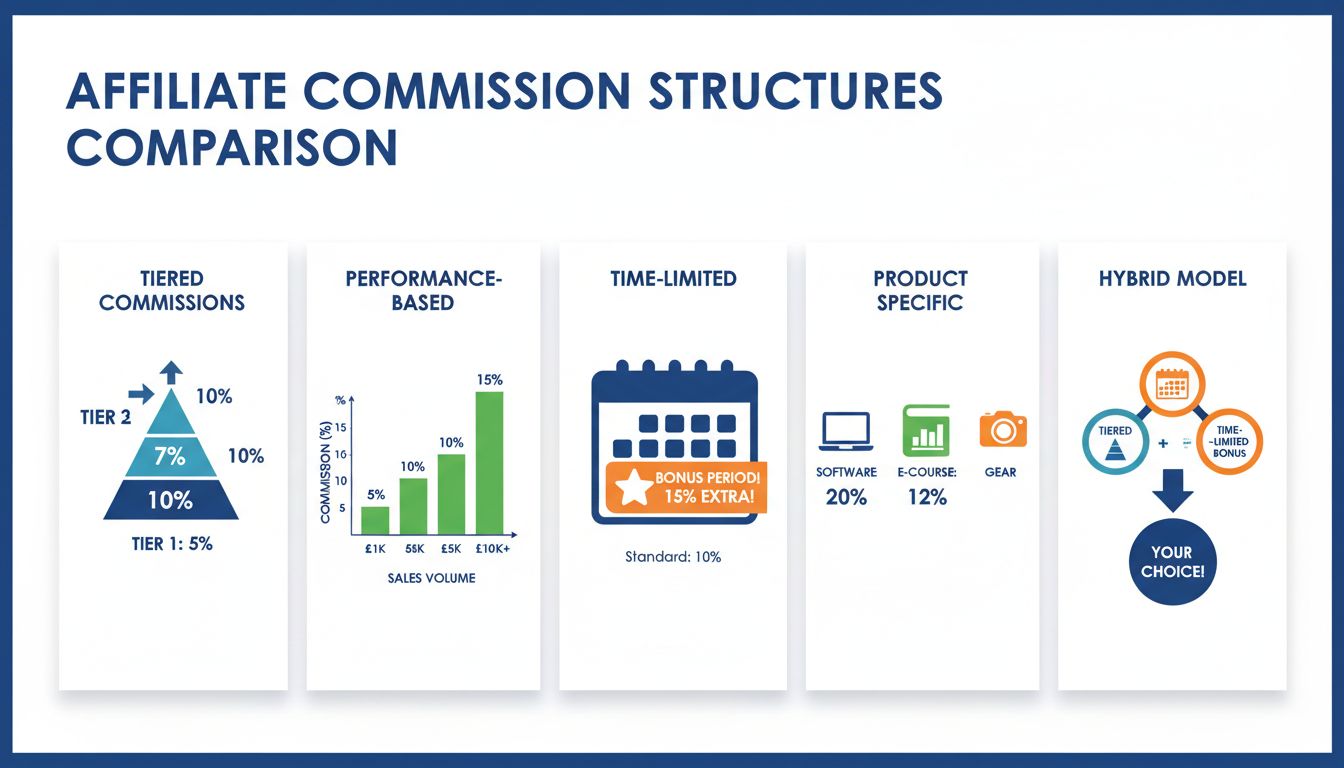
Different commission structures create distinct earning opportunities and incentive mechanisms for affiliates. Understanding these models helps you choose the right approach for your business goals and affiliate base.
Flat-Rate Commissions represent the simplest model, where affiliates earn a fixed percentage of each sale regardless of volume or performance. For instance, an affiliate might earn 10% on every sale, whether they generate 5 sales or 500 sales in a month. This model is easy to understand and implement but doesn’t reward high performers or encourage growth. Percentage-Based Commissions work similarly but are calculated as a percentage of the sale price, meaning higher-value sales generate higher absolute commissions. An affiliate earning 15% commission makes $15 on a $100 sale but $150 on a $1,000 sale. This structure naturally incentivizes affiliates to promote higher-value products and attract customers with greater purchasing power.
Tiered commission structures represent a significant advancement in affiliate program design, offering escalating commission rates as affiliates achieve higher sales volumes. This model directly addresses the challenge of motivating top performers while maintaining reasonable costs for lower-volume affiliates. A typical tiered structure might look like this: affiliates earning $0-$5,000 in monthly sales receive 5% commission, those generating $5,001-$10,000 receive 7%, and top performers exceeding $10,000 earn 10%. This approach creates clear incentives for growth and rewards consistency. For example, an affiliate generating $8,000 in sales would earn commissions on the first $5,000 at 5% ($250) and the remaining $3,000 at 7% ($210), totaling $460. The beauty of tiered structures lies in their ability to scale with your business—as affiliates grow, they earn more, creating a virtuous cycle of motivation and performance.
Performance-based commissions take a different approach by tying payouts to specific, measurable outcomes beyond simple sales volume. Rather than paying a percentage of every sale, merchants might pay different rates for different actions: $50 for a qualified lead, $100 for a trial signup, or 20% for a completed purchase. This model is particularly effective for B2B and SaaS companies where the sales cycle is longer and multiple touchpoints matter. Performance-based structures ensure you only pay for results that align with your business objectives, reducing wasted spend on low-quality traffic while rewarding affiliates who drive genuine value.
Many affiliate programs implement commission groups that assign different rates to various product categories or individual products. This strategy allows merchants to strategically promote high-margin items, new products, or inventory that needs to move. For example, an e-commerce retailer might offer 5% commission on general merchandise but 15% on clearance items they want to clear quickly, or 20% on newly launched products they want to gain market traction for. This differentiation helps affiliates understand which products generate the most value and encourages them to focus their promotional efforts accordingly. PostAffiliatePro excels at managing these complex product-specific commission structures, allowing merchants to set different rates for hundreds of products while maintaining transparent tracking and automated payouts.
| Commission Model | Typical Rate Range | Best For | Key Advantage |
|---|---|---|---|
| Flat-Rate | 5-15% | Simple programs, physical goods | Easy to understand and manage |
| Tiered | 5-20% (escalating) | Large affiliate networks | Motivates top performers |
| Performance-Based | $10-$500+ per action | B2B, SaaS, lead generation | Aligns with business objectives |
| Product-Specific | 2-50% (varies by product) | Multi-product merchants | Strategic inventory management |
| Recurring | 5-30% per billing cycle | Subscription services | Rewards long-term customer value |
| Hybrid | Mixed rates | Enterprise programs | Maximum flexibility |
Subscription-based businesses and SaaS companies often employ recurring commission structures that pay affiliates a percentage of each recurring payment a customer makes. This model creates a powerful incentive for affiliates to focus on customer quality and retention rather than just initial conversions. If an affiliate refers a customer to a $50/month subscription service with a 20% recurring commission, they earn $10 monthly for as long as that customer remains subscribed. Over a year, that single referral generates $120 in passive income for the affiliate. This structure aligns perfectly with the business model of subscription services, where customer lifetime value is paramount. Many successful SaaS companies attribute significant portions of their growth to recurring affiliate commissions, as they create long-term partnerships where both parties benefit from customer retention.
Merchants consider numerous factors when determining appropriate commission rates for their affiliate programs. Industry benchmarks provide crucial context—researching what competitors and similar businesses offer helps ensure your rates are competitive enough to attract quality affiliates. Affiliate acquisition costs must be factored into the equation; the commission you pay should exceed the cost of recruiting and supporting that affiliate while still generating profit. Customer lifetime value is particularly important for subscription and recurring revenue models, where a single affiliate referral might generate hundreds or thousands in revenue over time. Traffic quality varies significantly among affiliates, and some merchants implement quality-based commission adjustments, paying higher rates to affiliates who consistently deliver high-converting traffic. Seasonal variations also play a role, with many programs offering temporary commission increases during peak selling seasons like Black Friday, Cyber Monday, or holiday periods to boost affiliate engagement.
Modern affiliate programs increasingly employ hybrid commission models that combine multiple structures to achieve diverse business objectives. A hybrid model might include a base 5% commission on all sales, a 10% bonus for sales exceeding monthly targets, and an additional 15% commission specifically for new product launches. This complexity requires sophisticated tracking and automation, which is where platforms like PostAffiliatePro demonstrate their value. These advanced systems can manage multiple commission rules simultaneously, automatically calculate payouts based on complex criteria, and provide transparent reporting that builds trust with affiliates. Hybrid models are particularly effective for enterprise-level affiliate programs managing hundreds of partners across multiple product lines and geographic markets.
Successfully implementing commission variations requires clear communication, transparent tracking, and fair administration. Affiliates need to understand exactly how their commissions are calculated, what actions trigger payments, and how they can increase their earnings. Providing detailed commission documentation, offering tiered incentive structures that reward growth, and maintaining accurate, real-time tracking builds confidence in your program. PostAffiliatePro provides comprehensive commission management capabilities that automate these processes, reducing administrative overhead while ensuring accuracy and fairness. The platform’s advanced reporting features allow affiliates to see exactly how their efforts translate into earnings, creating the transparency that drives long-term program success and affiliate retention.
PostAffiliatePro provides advanced commission management tools that allow you to set flexible, product-specific commission rates, implement tiered structures, and automate payouts. Manage multiple commission models effortlessly and reward your top affiliates fairly.
Learn how affiliate commission rates are determined in 2025. Discover the key factors including profit margins, industry standards, CAC, and competitor analysis...
Discover typical affiliate commission rates in 2025. Learn how commissions vary by industry, product type, and program structure. Get insights on setting compet...
Discover the right affiliate commission rates for your business in 2025. Learn industry benchmarks, calculation methods, and strategies to attract top affiliate...
Join our community of happy clients and provide excellent customer support with Post Affiliate Pro.



Cookie Consent
We use cookies to enhance your browsing experience and analyze our traffic. See our privacy policy.