

Football Betting Affiliate Marketing: The World's Biggest Sport
Discover how to monetize football betting affiliate marketing. Learn strategies, top programs, and how PostAffiliatePro helps manage multiple betting partnershi...
9 min read

Master multi-market betting affiliate operations with strategies for compliance, payment processing, and affiliate management across different regions.
International betting affiliate operations represent one of the fastest-growing segments in the affiliate marketing industry, with the global online betting market projected to reach $231.5 billion by 2027, growing at a compound annual growth rate of 9.2%. Managing affiliate programs across multiple markets introduces significant complexity that extends far beyond traditional affiliate marketing, requiring operators to navigate fragmented regulatory landscapes, diverse player behaviors, multiple currencies, and varying compliance requirements. The betting affiliate sector differs fundamentally from other affiliate verticals because it operates in a heavily regulated environment where each jurisdiction imposes unique licensing requirements, advertising restrictions, and responsible gambling mandates that directly impact how affiliates can promote platforms. Regional variations in player preferences are dramatic—European players favor football and traditional sports betting, Asian markets show strong preference for esports and virtual sports, while North American players increasingly engage with mobile-first sportsbooks and live betting experiences. Understanding these nuances and implementing sophisticated management systems that can adapt to regional requirements while maintaining global operational efficiency is essential for operators seeking to scale their affiliate programs internationally.
Betting affiliates operate fundamentally differently from traditional e-commerce or SaaS affiliates because they promote services in a highly regulated industry where player lifetime value, deposit patterns, and gaming behavior directly influence commission calculations and profitability. The betting affiliate ecosystem relies on sophisticated commission models that account for player behavior metrics: Cost Per Acquisition (CPA) pays fixed amounts per depositing player, Revenue Share (RevShare) provides a percentage of net gaming revenue, and hybrid models combine both approaches to balance risk between operators and affiliates. Regional variations in player behavior are substantial—European players typically deposit larger amounts ($50-$200) with longer engagement periods, Asian players often prefer smaller deposits ($10-$50) with higher frequency, and North American players show strong preference for mobile betting with rapid deposit cycles. The global betting affiliate market generates approximately $8 billion in annual commissions, with Europe accounting for 45% of total affiliate revenue, Asia-Pacific 30%, and the Americas 25%, reflecting both market size and affiliate density in each region. Player acquisition costs vary dramatically by market and affiliate quality, ranging from $15 per depositing player in saturated European markets to $150+ in emerging regions, making affiliate tier management and performance-based incentives critical for maintaining profitability. Attribution challenges in betting are more complex than traditional affiliate marketing because players often interact with multiple touchpoints before depositing, requiring sophisticated multi-touch attribution models that accurately credit the affiliate responsible for the conversion while maintaining compliance with regional data protection regulations.
The regulatory environment for betting affiliates varies dramatically across jurisdictions, creating a complex compliance landscape that operators must navigate carefully to avoid penalties and license revocation. The United Kingdom, regulated by the Gambling Commission, requires all affiliates to be registered and verified, prohibits advertising to minors, mandates responsible gambling messaging on all promotional materials, and imposes strict rules on bonus advertising—violations can result in fines up to £100,000 and affiliate program suspension. The European Union presents a fragmented regulatory landscape where each member state maintains independent gambling regulations: Germany’s Glücksspielstaatsvertrag (State Treaty on Gambling) requires specific licensing for operators and affiliates, France’s Autorité Nationale des Jeux (ANJ) maintains strict advertising restrictions and player protection requirements, and Spain’s Dirección General de Ordenación del Juego enforces comprehensive compliance frameworks. Asia-Pacific regulations range from complete prohibition in Singapore and Hong Kong to regulated markets in the Philippines (PAGCOR licensing), Malaysia (limited licensing), and Australia (state-based regulation with strict advertising restrictions on television and online platforms). The Americas present perhaps the most complex regulatory environment, with 38+ US states maintaining independent gambling regulations, Canada’s provincial jurisdiction system creating 13 separate regulatory bodies, and Latin American countries implementing varying approaches from prohibition to regulated licensing. All major markets now mandate responsible gambling messaging, player protection mechanisms, anti-money laundering (AML) compliance, and strict data protection standards aligned with GDPR, CCPA, or equivalent regional regulations, requiring operators to implement comprehensive compliance monitoring systems and regular affiliate training programs.
Effective international betting affiliate operations require a sophisticated technology stack that integrates multiple specialized systems into a cohesive platform capable of handling real-time tracking, multi-currency transactions, compliance monitoring, and fraud detection across 24/7 operations spanning multiple time zones. The core infrastructure must include API-based affiliate management software that supports unlimited affiliate hierarchies and sub-affiliate structures, real-time conversion tracking through multiple methodologies (pixel-based JavaScript tracking, server-to-server API integration, and hybrid approaches), comprehensive CRM systems for affiliate relationship management, and advanced analytics platforms that provide real-time dashboards with customizable reporting. Modern solutions must support multi-currency transactions with real-time exchange rate handling, multi-language interfaces for global affiliate bases, and integration with diverse payment gateways including traditional banking systems, e-wallets, and cryptocurrency processors to accommodate regional payment preferences. Legacy systems and spreadsheet-based management fail in international operations because they cannot handle real-time data synchronization across multiple markets, lack fraud detection capabilities, cannot enforce compliance rules automatically, and create manual reconciliation nightmares when managing thousands of affiliates across different commission structures and payment schedules. Successful platforms employ microservices architecture that allows independent scaling of tracking, payment processing, and reporting functions, cloud-based infrastructure for global redundancy and low-latency access, and sophisticated fraud detection engines that analyze velocity patterns, geolocation anomalies, device fingerprints, and behavioral indicators to identify suspicious activities in real-time. Integration capabilities are paramount—the system must connect seamlessly with sportsbook platforms via APIs, payment processors for automated payouts, CRM systems for affiliate communication, and compliance monitoring tools to ensure all activities meet regional regulatory requirements.
International betting affiliate programs employ four primary commission models, each with distinct advantages and disadvantages depending on market maturity, player acquisition costs, and operator profitability targets. Cost Per Acquisition (CPA) models pay fixed amounts per depositing player—typically €50-€350 in Europe, $50-$300 in North America, and $20-$100 in emerging markets—providing predictable costs for operators but potentially limiting affiliate earnings if players have high lifetime values. Revenue Share (RevShare) models distribute a percentage of net gaming revenue (NGR), typically ranging from 20-50% depending on market and affiliate tier, aligning operator and affiliate interests but creating payment volatility and requiring sophisticated tracking of player wagering activity. Hybrid models combine CPA and RevShare elements, offering affiliates a guaranteed minimum per deposit plus a percentage of subsequent gaming revenue, balancing predictability with upside potential and becoming increasingly popular in competitive markets. Net Gaming Revenue (NGR)-based commissions, common in Europe, calculate commissions on the difference between player deposits and winnings, requiring real-time integration with sportsbook systems and sophisticated reconciliation processes but providing the most accurate reflection of actual operator profitability. Payment processing for international operations demands support for multiple methods: bank transfers (SEPA in Europe, ACH in North America), e-wallets (Skrill, Neteller, PayPal), cryptocurrency (Bitcoin, Ethereum), and local payment solutions specific to each market (local bank transfers in Asia, mobile money in emerging markets). Payment frequency strategies should offer flexibility—weekly payouts for high-performing affiliates to maintain motivation, monthly for standard affiliates to reduce processing costs, and quarterly for new or underperforming affiliates to manage cash flow. Minimum payment thresholds typically range from $20-$50 to accommodate affiliates of all sizes, with balances automatically rolling over to the next payment period if minimums aren’t met. Commission structures must be dynamically adjusted by market and affiliate tier: established markets with saturated competition may require 30-40% RevShare or €200+ CPA to attract quality affiliates, while emerging markets with lower acquisition costs can sustain 20-25% RevShare or €50-€100 CPA while maintaining profitability.
Successful international affiliate recruitment requires a multi-channel strategy that combines affiliate networks, direct recruitment, and relationship building with regional influencers and content creators who understand local player preferences and marketing dynamics. Affiliate networks like Awin, Impact, and Partnerstack provide access to established affiliate bases in multiple regions, though operators should supplement network recruitment with direct outreach to high-performing affiliates in target markets, particularly content creators, sports bloggers, and esports streamers with engaged audiences. Effective programs implement tiered affiliate structures that incentivize performance and retention: Standard tier for new affiliates with baseline commissions and support, Premium tier for affiliates generating €5,000+ monthly revenue with higher commissions (5-10% bonus) and dedicated account managers, and VIP tier for top performers generating €20,000+ monthly with custom commission structures and strategic partnership opportunities. Onboarding processes should be streamlined but comprehensive, typically requiring 3-5 business days from application to approval, including identity verification, compliance screening, payment method setup, and provision of marketing materials in the affiliate’s preferred language. Affiliates must receive comprehensive training on responsible gambling messaging, compliance requirements specific to their target markets, available commission structures, tracking link implementation, and performance optimization strategies—this training should be available in multiple languages and formats (video, documentation, live webinars). Marketing materials provision is critical for affiliate success: operators should provide pre-designed banners in multiple sizes, landing page templates, email templates, social media graphics, and video content that affiliates can customize with their branding while maintaining compliance with regulatory requirements. Performance-based incentive structures should reward quality over volume: offer 5-10% commission bonuses for affiliates maintaining player retention rates above 30%, 10-15% bonuses for affiliates generating players with lifetime values exceeding market averages, and special bonuses for affiliates entering new markets or promoting underperforming products. Quality control mechanisms must include regular compliance audits, performance reviews, and communication protocols that address underperforming affiliates through coaching and support rather than immediate termination, as affiliate relationships are long-term investments requiring ongoing management and optimization.
Effective tracking and analytics infrastructure is the backbone of successful international betting affiliate operations, requiring sophisticated real-time monitoring systems that can handle multiple currencies, languages, and regulatory frameworks simultaneously. Modern affiliate programs employ three primary conversion tracking methodologies: pixel-based tracking (JavaScript tags placed on conversion pages), server-to-server tracking (direct API communication between affiliate networks and sportsbooks), and hybrid API integration approaches that combine both methods for maximum accuracy and redundancy. Real-time tracking is essential because betting markets operate 24/7 across multiple time zones, and delays in data reporting can result in missed fraud detection opportunities, inaccurate commission calculations, and compliance violations in jurisdictions with strict reporting requirements. Key performance metrics that international betting affiliates must monitor include First Time Deposit (FTD) rates, Net Gaming Revenue (NGR) which accounts for player winnings and losses, Customer Lifetime Value (LTV) to assess long-term profitability, and Return on Ad Spend (ROAS) to evaluate campaign efficiency across different markets. Advanced attribution modeling—particularly multi-touch attribution that credits multiple touchpoints in a player’s journey—becomes critical when managing campaigns across diverse channels and markets, as it provides accurate insights into which marketing efforts drive the most valuable conversions. Additionally, affiliates must implement sophisticated fraud detection mechanisms including velocity checks (monitoring unusual deposit patterns), geolocation verification, device fingerprinting, and behavioral analysis to identify suspicious activities that could trigger chargebacks or regulatory scrutiny. Cookie restrictions imposed by GDPR, CCPA, and similar regulations in different markets necessitate a shift toward first-party data collection and server-side tracking solutions, making accurate reporting increasingly dependent on direct integration with sportsbook platforms rather than relying solely on third-party cookies.

PartnerMatrix is a comprehensive affiliate management platform designed specifically for iGaming and betting operators, offering multi-brand campaign creation, advanced tracking, and flexible commission structures. The platform excels in handling complex affiliate hierarchies and provides detailed reporting with real-time analytics. However, PartnerMatrix can be expensive for mid-sized operators, with pricing starting at $500+ monthly, and the interface can be overwhelming for smaller teams without dedicated affiliate management staff.
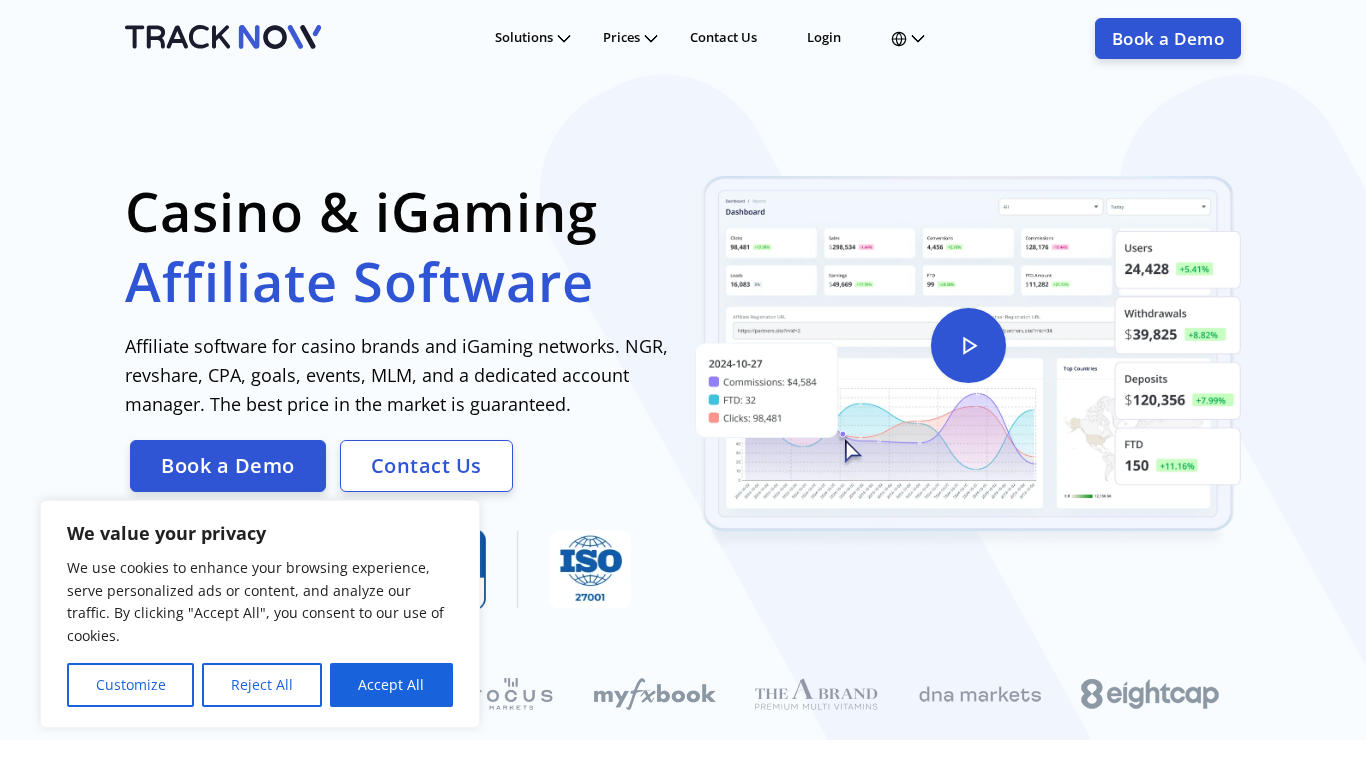
Tracknow provides robust iGaming affiliate management with strong emphasis on tracking accuracy, fraud detection, and compliance monitoring. The platform offers excellent value with pricing starting at $99/month for basic plans and $199/month for advanced features, includes a 14-day free trial, and provides comprehensive support. Tracknow’s main limitation is that it’s less customizable than enterprise solutions, making it better suited for mid-sized operators rather than large enterprises with complex requirements.

TheAffiliatePlatform specializes in gambling and betting affiliate management with strong multi-brand capabilities, comprehensive tracking, and flexible commission structures. The platform offers dedicated account managers, excellent customer support, and features specifically designed for the iGaming industry. However, pricing information is not publicly available, and the platform may require custom implementation for specific requirements.
| Feature | PostAffiliatePro | PartnerMatrix | Tracknow | TheAffiliatePlatform |
|---|---|---|---|---|
| Pricing | $99-$299/month | $500+/month | $99-$199/month | Custom pricing |
| Free Trial | 14 days | Demo available | 14 days | Demo available |
| Multi-Brand Support | ✓ Excellent | ✓ Excellent | ✓ Good | ✓ Excellent |
| Real-Time Tracking | ✓ Advanced | ✓ Advanced | ✓ Advanced | ✓ Advanced |
| Fraud Detection | ✓ Comprehensive | ✓ Comprehensive | ✓ Strong | ✓ Strong |
| Compliance Tools | ✓ Excellent | ✓ Good | ✓ Good | ✓ Excellent |
| Multi-Currency Support | ✓ 50+ currencies | ✓ Multiple | ✓ Multiple | ✓ Multiple |
| Payment Processing | ✓ 20+ methods | ✓ Multiple | ✓ Multiple | ✓ Multiple |
| Customization | ✓ Highly customizable | ✓ Very customizable | ✓ Moderate | ✓ Highly customizable |
| Customer Support | ✓ 24/7 | ✓ Business hours | ✓ 24/7 | ✓ Dedicated managers |
| Best For | Mid to large operators | Enterprise operators | Mid-sized operators | Betting specialists |
PostAffiliatePro stands out as the optimal choice for international betting affiliate operations because it combines enterprise-grade functionality with affordable pricing, making it accessible to operators of all sizes. The platform offers superior customization for complex affiliate hierarchies, better integration with betting platforms, comprehensive compliance tools designed specifically for regulated markets, and more responsive customer support. PostAffiliatePro’s flexible commission structures, advanced fraud detection, and real-time analytics provide the foundation needed to manage successful multi-market affiliate programs while maintaining profitability and regulatory compliance.
Successful international expansion in betting affiliate operations requires a methodical approach beginning with comprehensive market research that analyzes regulatory landscapes, competitive saturation, player demographics, preferred payment methods, and local betting preferences—for example, European markets may favor football betting while Asian markets show stronger interest in esports and virtual sports. Localization extends far beyond simple translation; it demands cultural adaptation of marketing messaging, selection of locally-relevant sports and events, adjustment of promotional offers to align with regional player expectations, and partnership with local payment processors that support preferred deposit methods in each market (such as Paysafecard in Europe, local bank transfers in Asia, or mobile money in emerging markets). Effective affiliate programs must implement dynamic commission structures that account for regional profitability differences, currency fluctuations, and varying player acquisition costs—for instance, offering higher commissions in competitive markets while maintaining sustainable margins in less saturated regions. Managing time zone differences across multiple markets requires establishing clear communication protocols, implementing 24/7 support systems (either through distributed teams or outsourced support partners), and scheduling regular check-ins that accommodate different working hours to ensure affiliates receive timely assistance with campaign optimization and technical issues. Building strong relationships with regional affiliate networks and local influencers provides invaluable market insights and accelerates player acquisition, as these partners understand local player behavior, preferred marketing channels, and regulatory nuances that external teams may overlook. Hiring or contracting with local teams—whether for customer support, marketing, or compliance—significantly improves market responsiveness and cultural relevance, as local team members can quickly identify emerging trends, adapt to regulatory changes, and maintain authentic communication with regional affiliate partners. Maintaining consistent brand messaging while allowing regional flexibility creates a cohesive global presence; this means establishing core brand values and compliance standards that apply universally while permitting local teams autonomy in creative execution, promotional calendars, and partnership strategies.
Managing international betting affiliate operations successfully requires a sophisticated, multi-layered approach that balances global standardization with local market adaptation, combining robust tracking infrastructure, strategic market expansion planning, and strong affiliate relationship management to create sustainable competitive advantages. The foundation of this success rests on three critical pillars: implementing comprehensive tracking and analytics systems that provide real-time visibility into campaign performance across all markets while maintaining compliance with regional data protection regulations; developing strategic expansion frameworks that prioritize market research, cultural localization, and partnership building over rapid, unfocused growth; and maintaining the highest standards of affiliate relationship management through transparent communication, fair commission structures, and responsive support. As the international betting affiliate landscape becomes increasingly competitive and regulated, organizations that invest in proper affiliate management software—platforms that integrate tracking, compliance monitoring, multi-currency payment processing, and affiliate communication tools—gain significant operational efficiency and reduce the risk of costly compliance violations or payment disputes. The competitive advantage of proper multi-market management manifests in multiple ways: improved player acquisition costs through optimized regional campaigns, reduced churn through culturally-relevant marketing, enhanced fraud prevention through sophisticated analytics, and stronger affiliate loyalty through transparent, efficient operations. If your organization is currently managing international betting affiliate operations through fragmented systems, spreadsheets, or outdated affiliate management platforms, now is the time to evaluate your infrastructure and consider upgrading to a comprehensive, modern solution designed specifically for the complexities of global betting operations—the investment in proper systems today will pay dividends through improved margins, reduced compliance risks, and accelerated market expansion tomorrow.
The primary challenges include navigating complex regulatory requirements that vary by jurisdiction, managing multiple currencies and payment methods, maintaining compliance across different markets, detecting and preventing fraud, and recruiting quality affiliates in competitive regions. Each market has unique player preferences, advertising restrictions, and responsible gambling requirements that require localized strategies.
Commission models vary significantly by region and market maturity. Established markets like the UK and Europe typically offer 20-40% revenue share or €100-€350 CPA, while emerging markets may offer higher rates to attract affiliates. NGR-based commissions are common in Europe, while deposit-based CPA models work better in Asia. Operators must balance competitive rates with profitability and adjust structures based on player acquisition costs in each market.
A robust tech stack requires API-based affiliate management software, real-time tracking systems (pixel-based and server-to-server), multi-currency payment processing, CRM integration, advanced fraud detection, and compliance monitoring tools. The system must support multiple languages, handle 24/7 operations across time zones, provide real-time analytics, and integrate with various payment gateways and sportsbook platforms.
Compliance is absolutely critical and non-negotiable. Different jurisdictions have strict regulations regarding advertising, responsible gambling messaging, affiliate verification, and data protection. Non-compliance can result in hefty fines, license revocation, and reputational damage. Operators must implement compliance monitoring tools, regular audits, affiliate training, and maintain detailed records of all affiliate activities and player interactions.
Successful recruitment involves partnering with established affiliate networks in target regions, attending industry conferences, building relationships with local influencers and content creators, offering competitive commission structures, and providing comprehensive support. Quality matters more than quantity—focus on affiliates with relevant audiences and proven track records. Implement tiered programs to incentivize performance and retention.
Fraud prevention requires multi-layered approaches including real-time tracking with velocity checks, geolocation verification, device fingerprinting, behavioral analysis, and integration with payment processors' fraud detection systems. Monitor for suspicious patterns like unusual deposit amounts, rapid account creation, or players from restricted jurisdictions. Implement strict KYC (Know Your Customer) procedures and maintain audit trails of all affiliate activities.
Successful programs support diverse payment methods including bank transfers, e-wallets (Skrill, Neteller, PayPal), cryptocurrency, and local payment solutions specific to each market. Payment frequency should be flexible—weekly or monthly options—with low minimum thresholds ($20-$50) to accommodate affiliates of all sizes. Multi-currency support is essential to reduce conversion costs and appeal to global affiliates.
PostAffiliatePro stands out with its comprehensive multi-market capabilities, advanced compliance tools, flexible commission structures, real-time tracking, and dedicated support for betting operators. Unlike competitors, PostAffiliatePro offers superior customization for complex affiliate hierarchies, better integration with betting platforms, and more affordable pricing for mid-sized operators. It's specifically designed for the unique needs of international betting operations.
PostAffiliatePro provides comprehensive multi-market affiliate management with real-time tracking, compliance tools, and flexible commission structures designed specifically for betting operators.
Discover how to monetize football betting affiliate marketing. Learn strategies, top programs, and how PostAffiliatePro helps manage multiple betting partnershi...
Learn how to value your betting affiliate site and execute a successful exit strategy. Discover valuation formulas, key drivers, and proven tactics to maximize ...

Navigate Germany's complex gambling regulations. Learn the key differences between casino and sports betting rules, GGL compliance requirements, and proven affi...
Join our community of happy clients and provide excellent customer support with Post Affiliate Pro.



